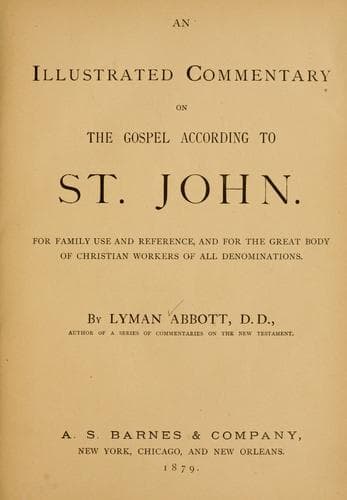
An illustrated commentary on the Gospel according to St. JohnAbbott, Lyman
Religion
An illustrated commentary on the Gospel according to St. John
Abbott, Lyman
Bible. John -- Commentaries
=22. When therefore he was risen from the dead.= Not merely after but
at the time of his resurrection and in the light of that fact, the
disciples interpreted both what he had said and what the O. T.
contained on this subject.--=They believed the Scripture.= Not the N.
T., no part of which was written at the time of the resurrection; and
the “Scripture” is here distinguished from the words which Jesus had
spoken. The O. T. contained prophecies of the resurrection which are
enigmatical, and probably were but imperfectly comprehended by even
the most devout Jews, but which were interpreted by the event (Ps.
16:4 with Acts 3:15; Ps. 17:15; 73:23, 24; Isaiah 26:19; Hosea 6:2).
For evidence that Christ, and subsequently the apostles, recognized in
the O. T. prophecies of the resurrection, see Luke 24:26, 27; John
20:9; 1 Cor. 15:4.
23 Now when he was in Jerusalem at the passover, in the
feast _day_, many believed in his name when they saw the
miracles which he did.
24 But Jesus did not commit himself unto them, because
he[84] knew all _men_,
[84] ch. 16:30; 1 Sam. 16:7; 1 Chron. 28:9; 29:17;
Jer. 17:9, 10; Matt. 9:4; Acts 1:24; Rev. 2:23.
25 And needed not that any should testify of man: for
he knew what was in man.
=23-25. Many trusted in his name, seeing the signs which he wrought,
but Christ did not entrust himself to them, because he knew all men
and needed not=, etc. Compare with the English version the translation
here given which approximates more nearly to the original; and observe
respecting this that (1) the term miracle has acquired in modern
theology a technical meaning it does not possess in the N. T. Christ
may have wrought miracles at this time not recorded by the Evangelist
(ch. 21, 25), but the belief of the Jewish disciples may have rested
on such signs of his moral power as the expulsion of the traders from
the temple; (2) their trust in his name was not necessarily a true
spiritual acceptance of him as a personal Saviour from sin; the
reverse is implied by the statement that they trusted him _because
they saw his miracles_; and still more by the declaration respecting
himself that he did not entrust himself to them; (3) this declaration
would scarcely need interpretation were it not for a common
misinterpretation. It does not imply that he held back from them his
doctrine, or refused to work miracles for their benefit, but simply
that he did not and could not enter into that close and unreserved
personal intercourse with them which characterized his Galilean life
and companionships. He knew them too well to do this; knew that when
the spiritual and universal nature of his kingdom of love was revealed
unto them, they would reject and crucify him. The statement that he
knew what was _in man_, indicates a divine and supernatural reading of
the secrets of the human heart, of which the N. T. affords many and
striking illustrations (Matt.
Public-domain text, read in full here on John Shaqi.
Reviews
Reviews
No reviews yet
Be the first to share your thoughts on this work.
Elsewhere in the archive
Join the Discussion
Join the discussion
Sign in to leave a comment or review.
Sign InorCreate an account