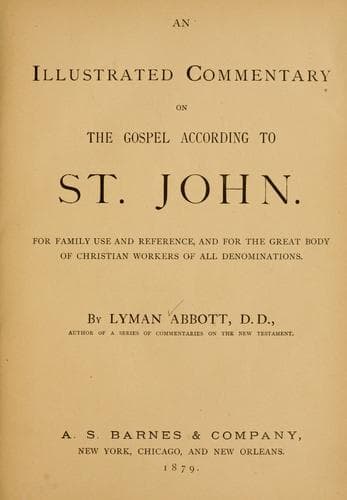
An illustrated commentary on the Gospel according to St. JohnAbbott, Lyman
Religion
An illustrated commentary on the Gospel according to St. John
Abbott, Lyman
Bible. John -- Commentaries
9:4; Mark 2:8; Luke 7:39, 40). The
declaration that he knew _all men_, indicates that this interior
knowledge of the heart was not occasional and exceptional, but
universal. Melancthon sees in the example of our Lord here an
admonition of caution in opening our hearts unreservedly to strangers,
even though they may seem to receive our word with kindness. Be
friendly to all, be intimate with few.
CHAPTER III.
Ch. 3:1-21. CHRIST’S CONVERSATION WITH NICODEMUS.--THE ARGUMENT FROM
MIRACLES: ITS STRENGTH AND ITS WEAKNESS ILLUSTRATED (verse 2).--CHRIST
MORE THAN A TEACHER, A LIFE-GIVER; CHRISTIANITY MORE THAN A SYSTEM
OF TRUTH, A NEW LIFE.--THE CONDITION OF SPIRITUAL KNOWLEDGE, A NEW
SPIRITUAL LIFE.--THE SPIRIT OF SKEPTICISM ILLUSTRATED (verse 4).--THE
TRUE METHOD OF ANSWERING SKEPTICISM, NOT BY ARGUMENT, BUT BY PERSONAL
ASSURED CONVICTION (verse 5).--THE TWO CONDITIONS OF ENTERING CHRIST’S
KINGDOM: A NEW SPIRITUAL LIFE, AND A PUBLIC CONFESSION OF CHRIST (verse
5).--LIKE BEGETS LIKE.--THE KNOWN AND THE UNKNOWN IN THEOLOGY (verses
8, 11): THE KNOWN, WHAT TAKES PLACE ON EARTH; THE UNKNOWN, WHAT TAKES
PLACE IN HEAVEN.--THE IGNORANCE OF THE WISE; HE IS NO MASTER WHO HAS
NO PERSONAL KNOWLEDGE OF THE NEW BIRTH.--THE POWER OF SALVATION:
A CRUCIFIED CHRIST; THE CONDITION OF SALVATION: FAITH IN HIM; THE
CONDEMNATION OF SINNERS: THEIR LOVE OF DARKNESS AND REJECTION OF THE
LIGHT.
Christ’s interview with Nicodemus is described only by John. It
occurred immediately after the events described in the preceding
chapter, and before Christ had inaugurated his missionary labors,
which he did not begin till the imprisonment of John the Baptist (Mark
1:14). In studying this passage, the following considerations will
prevent the student from falling into the perplexities and errors into
which some learned and orthodox commentators have fallen. (1) The
conversation was had at the commencement of Christ’s ministry, before
he had explained, even to his own disciples, the principles of his
kingdom; we cannot therefore safely assume that Nicodemus was familiar
with those principles, nor can we interpret Christ’s teachings here by
the later apostolic teaching, except in so far as that was developed
from this as from a germ. (2) Nicodemus was a Pharisee, therefore a
formalist, and pre-eminently a Jew. We may safely assume that Christ’s
object was in part to correct Jewish and Pharisaic errors, and
our first object must be to understand, if we can, Nicodemus’
understanding of our Lord. (3) There is no evidence that John was
present at this interview; and it is not probable that we have a full
verbatim report of it. The structure of the narrative indicates that
only so much of the conversation is reported as was necessary to make
clear Christ’s discourse founded thereon.
1 There was a man of the Pharisees, named Nicodemus,[85] a
ruler of the Jews:
[85] ch. 7:50, 51; 19:39.
Public-domain text, read in full here on John Shaqi.
Reviews
Reviews
No reviews yet
Be the first to share your thoughts on this work.
Elsewhere in the archive
Join the Discussion
Join the discussion
Sign in to leave a comment or review.
Sign InorCreate an account