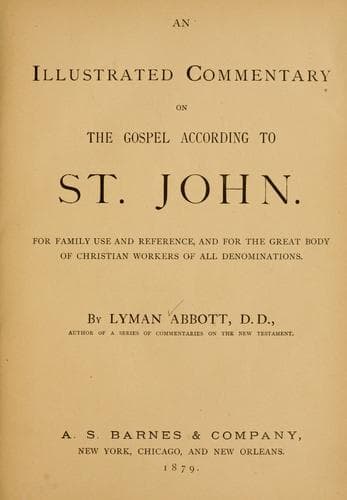
An illustrated commentary on the Gospel according to St. JohnAbbott, Lyman
Religion
An illustrated commentary on the Gospel according to St. John
Abbott, Lyman
Bible. John -- Commentaries
understanding of this conversation is the contrast between the two
conceptions of religion, as a system of doctrine, and as a new and
spiritual life.
3 Jesus answered and said unto him, Verily, verily, I say
unto thee, Except[88] a man be born again, he cannot see
the kingdom of God.
[88] ch. 1:13; Gal. 6:15; Eph. 2:1; Tit. 3:5; James
1:18; 1 Peter 1:23; 1 John 2:29; 3:9.
=3. Verily, verily.= With Christ these words are a common precursor of
any especially weighty and solemn declaration (Matt. 5:18,
note).--=Except a man be begotten anew, he cannot see the kingdom of
God.= On the meaning of this sentence, it is to be observed that, (1)
The word (γεννάω) here rendered in our English version _born_, more
properly signifies the act of begetting. Here therefore Christ’s
language carries Nicodemus back to the very beginning of life. (2) The
word (ἄνωθεν) rendered here in our English version _again_, is
certainly mistranslated. It means either _anew, i. e., from the
beginning_ or _from above_. Both meanings are attached to it here by
the best scholars. According to the first definition, Christ simply
implies that the life must begin anew, that the character must be
rebuilt from the foundation, without however implying how; according
to the other idea, he indicates in the use of this word not only a new
but a spiritual and divine birth. The word is used in the first sense
in Luke 1:3, where it is rendered _from the very first_; in the second
sense in James 1:17; 3:15, 17, where it is rendered _from above_. It
is clear that Nicodemus understood it in the former sense merely, and
therefore I have so rendered it here. (3) The word rendered _see_
(ἰδεῖν) is not equivalent to _enter into_ (εἰσελθεῖν), as Meyer
interprets it. The declaration is explicit that a new spiritual life
is necessary, not only to enter into but even to form any correct
conception of the kingdom of God. And with this agrees the teaching of
Christ elsewhere (Matt. 13:14, 15), and of Paul (1 Cor. 2:9, 14, 15).
Christ thus declares to Nicodemus that he cannot even understand the
spiritual teachings of the new religion without first beginning a new
life. In other words, _a new spiritual life is the condition precedent
to a correct spiritual apprehension of Christ’s teaching_. It is
further to be observed that light is thrown on the meaning of this
declaration by a consideration of previous Rabbinical and of later
Apostolic teaching. The new birth was a familiar metaphor with the
Rabbis. They held that a Gentile in becoming a Jewish proselyte, and
submitting to circumcision and baptism, was born again. Old things
passed away; all things became new; it was even maintained that the
proselyte might marry his nearest kin without offence, because the old
relationships were annulled by his new birth. Christ employs this
metaphor, familiar to the Jewish Rabbi, without interpreting it, and
Public-domain text, read in full here on John Shaqi.
Reviews
Reviews
No reviews yet
Be the first to share your thoughts on this work.
Elsewhere in the archive
Join the Discussion
Join the discussion
Sign in to leave a comment or review.
Sign InorCreate an account