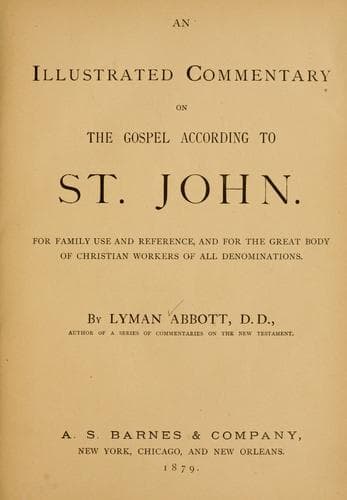
An illustrated commentary on the Gospel according to St. JohnAbbott, Lyman
Religion
An illustrated commentary on the Gospel according to St. John
Abbott, Lyman
Bible. John -- Commentaries
=1. There was a man of the Pharisees named Nicodemus.= Of Nicodemus
nothing is known except what John tells us. He is not mentioned by the
other Evangelists; and subsequent traditions are untrustworthy. There
is a Nicodemus referred to in the Talmud; but there is nothing to
identify him with this one, for the name was common among the Jews.
The only incidents related of him are this conference, his protest
against condemning Jesus unheard (ch. 7:50-52), and his participation
with Joseph of Arimathea in the burial of Jesus (ch. 19:39). There is
a spurious Gospel of Nicodemus, the author of which is, however,
unknown. The designation of him here as a _ruler of the Jews_
indicates that he was one of the Sanhedrim, and this indication is
confirmed by ch. 7:50. On the character of the Pharisees, see Matt.
3:7, note. Among them there were some pure and honest souls, sincere
but not courageous seekers after the truth (Mark 12:28-34; 15:43; Acts
5:34-39; 15:5; Phil. 3:5); to this class of the Pharisees Nicodemus
seems to have belonged.
[Illustration: A MODERN JEWISH RABBI.]
2 The same came to Jesus by night, and said unto him,
Rabbi, we know that thou art a teacher come from God,
for[86] no man can do these miracles that thou doest,
except God[87] be with him.
[86] ch. 9:16, 33; Acts 2:22.
[87] Acts 10:38.
=2. The same came to Jesus by night.= Why _by night_? The reason
generally assumed is fear of the Jews; but this is not asserted by the
Evangelist, and at this time there had not been developed any
pronounced hostility on the part of the Judeans to Jesus. Nicodemus
may have had a natural reluctance to commit himself to an unknown
Rabbi, till he had learned more of his doctrine; he may have simply
sought a quiet and personal conversation, such as he could not obtain
in the busy day-time.--=Rabbi, we know that thou art a teacher.= The
plural is not used here for the singular number; Nicodemus expresses
not merely his own personal conviction, but that of the Pharisees as a
class. That they did, even much later, recognize Christ’s superhuman
character and mission is clear from such passages as Matt. 12:23, 24;
John 9:29-34; 11:47, and this even when they resisted him most
bitterly.--=For no man can do these miracles=, etc. This is the
argument from miracles put in the tersest possible form. Comp. Acts
4:16, 17. And this is all that miracles prove, namely, the commission
and authority of Christ; they do not of themselves show his
_character_. Nicodemus then regards Christ as a _prophet sent from
God_; and John, who in ch. 1:6, etc., has drawn clearly the
distinction between the prophet and the Light and Life, reports in
this conversation with Nicodemus a discourse of Christ in which he
emphasizes the same distinction. Nicodemus impliedly asks to know what
_new doctrine_ Christ has to teach; Christ replies in substance that
the world needs not new doctrine, but _new life_. The key to the
Public-domain text, read in full here on John Shaqi.
Reviews
Reviews
No reviews yet
Be the first to share your thoughts on this work.
Elsewhere in the archive
Join the Discussion
Join the discussion
Sign in to leave a comment or review.
Sign InorCreate an account