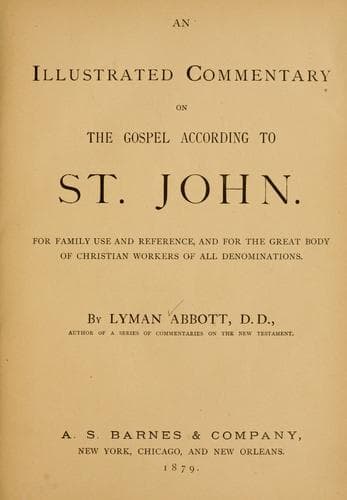
An illustrated commentary on the Gospel according to St. JohnAbbott, Lyman
Religion
An illustrated commentary on the Gospel according to St. John
Abbott, Lyman
Bible. John -- Commentaries
=5. Born of water and of Spirit.= Governing ourselves by the cardinal
canon, that we are to understand Christ as Christ expected his auditor
to understand him, it cannot be difficult to understand this
declaration. The Jewish proselyte, as a sign that he put off his old
faiths, was baptized on entering the Jewish church. John the Baptist,
employing the same symbolic rite, baptized Jew as well as Gentile, as
a sign of purification by repentance from past sins. The Sanhedrim
were familiar with his baptism, and had sent a delegation to inquire
into it (ch. 1:19, 25), and he had told them prophetically of the
baptism of the Spirit which Christ would inaugurate. Nicodemus then
would certainly have understood by Christ’s expression, “born of
water,” a reference to this rite of baptism, and by the expression,
“born of the Spirit,” a reference to a new spiritual life, which
however he could have only imperfectly apprehended. The declaration
then is that no man can enter the kingdom of God except by (1) a
_public_ acknowledgment and confession of sin, a _public_ putting off
of the old man and entering into the new; and (2) a real and vital
change of life and character wrought by the Spirit of God in the heart
of the believer. By the one act he enters into the visible and
external kingdom; by the other, into the spiritual and invisible
kingdom. That a _public_ confession and consecration is essential is
clearly indicated elsewhere in Christ’s teaching (Matt. 10:32, 33).
Observe the difference in phraseology here and in verse 3. He cannot
_see_ the kingdom of God, except his eyes are opened by the Spirit of
God; he cannot _enter_ it, except by a public and complete abandonment
of the old and a spiritual consecration to the new life (2 Cor.
5:14-16).
6 That[91] which is born of the flesh is flesh; and that
which is born of the Spirit is spirit.
[91] 1 Cor. 15:47, 49; 2 Cor. 5:17.
=6. That which is born of flesh is flesh.= The connection is this:
even if a man when he is old could enter again his mother’s womb and
be born, it would avail nothing; that which is born of flesh is always
flesh; only that which is born of the Spirit partakes of the Spirit of
God. (Comp. Rom. 8:5-9.) The declaration here, coupled with John’s
explicit declaration in ch. 1:14, that the Word was made flesh,
implies that the birth of Jesus was supernatural, though he narrates
none of the circumstances of that birth.
7 Marvel not that I said unto thee, Ye must be born again.
Public-domain text, read in full here on John Shaqi.
Reviews
Reviews
No reviews yet
Be the first to share your thoughts on this work.
Elsewhere in the archive
Join the Discussion
Join the discussion
Sign in to leave a comment or review.
Sign InorCreate an account