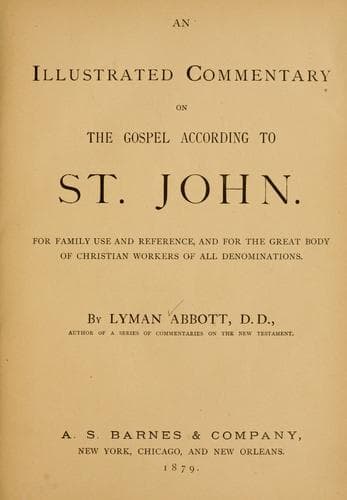
An illustrated commentary on the Gospel according to St. JohnAbbott, Lyman
Religion
An illustrated commentary on the Gospel according to St. John
Abbott, Lyman
Bible. John -- Commentaries
=7. Marvel not that I said unto thee, Ye must be born again.= The
original, by its construction, puts an emphasis on the word _ye_. And
it was this which surprised Nicodemus; not that men must be born
again, but that this necessity was laid on him, a child of Abraham,
and an honored ruler and teacher among the Jews. Observe too that he
says _ye_, not _we_. “The Lord did not, could not say this of Himself.
Why? Because, in the full sense in which the flesh is incapacitated
from entering the kingdom of God, He was not born of the flesh. He
inherited the weakness of the flesh, but his spirit was not like that
of sinful man, alien from holiness and God, and therefore on Him no
sentence hath passed; when the Holy Spirit descended on Him at His
baptism, the words spoken by the Father were indicative of past
approval, not of renewal. His obedience was accepted as perfect, and
the good pleasure of the Father rested on Him. Therefore He includes
not himself in this necessity for the new birth.”--(_Alford._)
8 The wind bloweth where it listeth, and thou hearest the
sound thereof, but canst not tell whence it cometh, and
whither it goeth: so[92] is every one that is born of the
Spirit.
[92] 1 Cor. 2:11.
=8.= It is very difficult to convey the exact meaning of the original
of this verse; for in the original the same word signifies _wind_ and
_spirit_; there is thus a verbal felicity in the metaphor, a certain
play upon the word itself, which cannot be transferred from the Greek
into another language. As in nature we see the operation of the summer
breeze, that comes we know not whence, and goes we know not whither,
so in the kingdom of grace we see the effects of the Spirit of God, in
changes wrought in the individual character and in the community (Gal.
5:22), but are unable to comprehend the nature of the influence or the
laws according to which it operates. Christ by this metaphor certainly
indicates something more than the mere incomprehensibleness of the
Spirit’s work (comp. Eccles. 11:5); he indicates also the realm in
which we are to conduct our investigations, and that from which, by
the nature of the case, we are excluded. We can study to advantage the
_results_ of the Spirit’s operations; but all endeavors to know _how
He_ operates, what are the occult laws of _His_ being and work, are in
vain. A humble acceptance of this teaching would eliminate many
useless discussions from theology. Alford notices that the Greek word
used for wind (πνεῦμα) indicates the gentle breath of summer, not the
violent gale. “It is one of those sudden breezes springing up on a
calm day, which has no apparent direction, but we hear it rustling in
the leaves around.” Observe also in the language, _where it listeth_,
an indication of the fact that the divine operations are free,
unconstrained, and not answerable to man, nor subject to his control.
Comp. Rom. 9:15, 16.
Public-domain text, read in full here on John Shaqi.
Reviews
Reviews
No reviews yet
Be the first to share your thoughts on this work.
Elsewhere in the archive
Join the Discussion
Join the discussion
Sign in to leave a comment or review.
Sign InorCreate an account