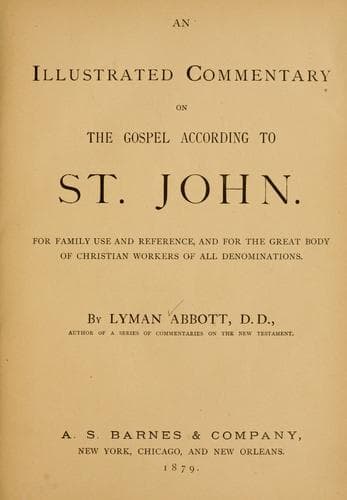
An illustrated commentary on the Gospel according to St. JohnAbbott, Lyman
Religion
An illustrated commentary on the Gospel according to St. John
Abbott, Lyman
Bible. John -- Commentaries
=14, 15. As Moses lifted up the serpent in the wilderness.= The
reference here is to the event recorded in Num. 21:4-9. The account
there should be carefully studied and compared with the spiritual
interpretation which Christ affords here. What species are there
indicated by the description “fiery serpent” is not very clear;
probably the title was given from the burning sensations produced by
their bite. Travelers describe a large serpent, said to abound in the
Arabian peninsula, full of fiery red spots and undulating stripes,
and regarded as one of the most poisonous of the serpent kind.
Excruciating heat and a burning thirst are among the symptoms produced
by the bite of this serpent. The brazen serpent described in Numbers
is thought to have been put upon a pole and carried throughout the
camp, so as to bring it within the sight of all the people. It was
carefully preserved and carried into the Holy Land, where it became an
object of idolatry and was destroyed in the reformation instituted
under Hezekiah (2 Kings 18:4). A Roman Catholic church at Milan,
Italy, however, still claims to possess the original brazen
serpent.--=Must the Son of Man be lifted up.= Why _must_? What is the
necessity? That question Christ does not answer here, nor, so far as I
can see, does the N. T. anywhere. It simply represents the atoning
sacrifice of Christ as a necessity, without explaining the grounds of
that necessity (comp. Luke 24:26). That it is in the divine economy of
grace an inexorable necessity is indicated even by the types of the O.
T. (Lev. 17:11; Heb. 9:22). The phrase “Son of Man” was a common
Jewish designation for the Messiah. It would have been so understood
by Nicodemus (Matt. 10:23, note).--=Be lifted up.= Not only _on the
cross_, but _by the cross unto glory_. It is the cross which lifts up
Christ to be the object of adoration for the whole creation (Phil.
2:9; Rev. 5:9).--=Should not perish.= These words are wanting in the
best manuscripts. But the doctrine implied, that those who do not
believe will perish, is clearly taught in verse 16, from which it was
probably borrowed and inserted here by some early copyist.--=Eternal
life.= The same Greek words are rendered everlasting life in the next
verse (ζωὴν αἰώνιον). Comp. ch. 10:10. Eternal life is the life of the
soul which disaster cannot impair nor death destroy--a present
possession, not a future inheritance, except that it is a possession
which grows in value and importance in the future.
Public-domain text, read in full here on John Shaqi.
Reviews
Reviews
No reviews yet
Be the first to share your thoughts on this work.
Elsewhere in the archive
Join the Discussion
Join the discussion
Sign in to leave a comment or review.
Sign InorCreate an account