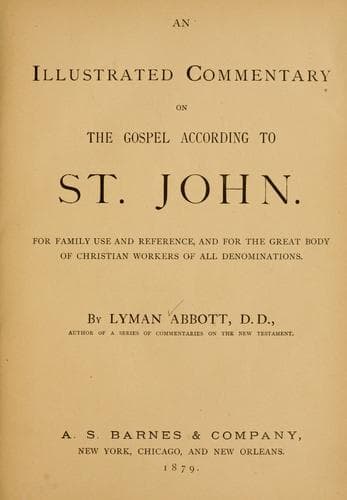
An illustrated commentary on the Gospel according to St. JohnAbbott, Lyman
Religion
An illustrated commentary on the Gospel according to St. John
Abbott, Lyman
Bible. John -- Commentaries
In studying Christ’s language in these two verses observe (1) That we
have Christ’s authority for the doctrine that the O. T. history is
intended to indicate, by types or object-teaching, the great truths of
the Gospel. This he assumes elsewhere in his ministry (Luke 22:15, 19,
20; John 6:49-51), and it is directly asserted by Paul (1 Cor. 10:11),
and underlies the Epistle to the Hebrews. The history of the brazen
serpent is then a parable of the Gospel; parabolically it points out
the way of salvation. (2) The serpent is throughout the Bible an
emblem of Satan, and its poison an emblem of the deadly and pervasive
effects of sin (Gen. 3:1, 14, 15; Deut. 32:33; Psalm 58:4, 5; 140:3;
Rom. 3:13; 2 Cor. 11:3; Rev. 12:9). It is a fitting emblem--slight in
its first wound, affecting the blood, the current and fountain of
life, pervading the whole frame with its subtle poison, a poison for
which there is no human remedy, and resulting in certain death. (3)
For the human soul, poisoned by sin, the end whereof is death (James
1:15), there is lifted up One who, though he knew no sin, was made in
the likeness of sinful flesh (2 Cor. 6:21), so that in him the enemy
himself was, as it were, nailed to the cross (Col. 2:15). Thus, as the
brazen serpent represented the fiery serpent, yet had in him not
poison but healing, so Christ represented sinful flesh, but had in him
no sin but redemption from the poison of sin in others. (4) The one
only condition of healing to the poisoned Israelite was that he _look
on_ the brazen serpent; and this simply as an act of obedient faith.
To this fact Isaiah had reference in his interpretation of the divine
condition of salvation, “Look unto me, and be ye saved, all the ends
of the earth; for I am God, and there is none else” (Isaiah 45:22). So
here to “believe in him” is not to believe some doctrine about the
Messiah, but simply to trust in him, to look unto him (Acts 16:31;
Heb. 12:2). (5) The work of heralding the Gospel is the work of Moses
in the wilderness. It is a simple pointing to the Saviour, lifted up
that the sinner, by looking unto him, may be saved. The work of
instruction in the precepts of Christ and the principles of his
kingdom comes after, not before, salvation (Matt. 28:19, 20, note).
16 For God[97] so loved the world, that he gave his only
begotten Son, that whosoever believeth in him should not
perish, but have everlasting life.
[97] 1 John 4:9.
Public-domain text, read in full here on John Shaqi.
Reviews
Reviews
No reviews yet
Be the first to share your thoughts on this work.
Elsewhere in the archive
Join the Discussion
Join the discussion
Sign in to leave a comment or review.
Sign InorCreate an account