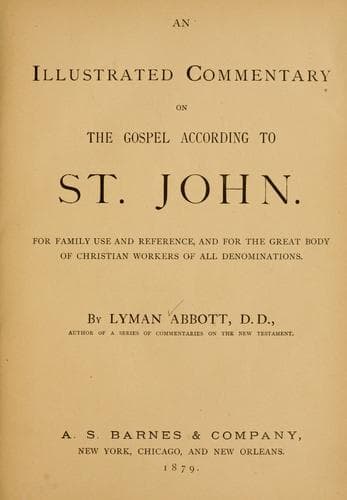
An illustrated commentary on the Gospel according to St. JohnAbbott, Lyman
Religion
An illustrated commentary on the Gospel according to St. John
Abbott, Lyman
Bible. John -- Commentaries
=16.= Some scholars, including Olshausen and Tholuck, suppose that
Christ’s discourse ends with the preceding verse, and that the
remainder, to verse 21, are added by John; but the grounds for such an
hypothesis seem to me quite insufficient, and the objections to it
quite conclusive. The grounds are (_a_) _That all allusion to
Nicodemus is henceforth dropped_. But Nicodemus is only introduced as
an interrogator, because his questions elicit the instruction of
Jesus; and only so much of his share in the conversation is recorded
as is necessary to make Christ’s language intelligible. (_b_)
_Thenceforth past tenses are used._ This might, however, well be the
case, even if the events were future, the discourse being prophetic.
But the events were not future, but past. The love of God, the sending
his Son into the world, the opening of the door of salvation through
Him--all this was already accomplished; and the passion is not
described in detail as an event past. (_c_) _The phrase “only
begotten” is said to be peculiar to John._ But Stier well replies that
John probably obtained the phrase from Christ. The objections to the
view which supposes that Christ ends the discourse at verse 15, and
that the rest is John’s are, (_a_) That the discourse breaks off
abruptly, if ended at verse 15, leaving Nicodemus in entire ignorance
of the way of salvation. The same necessity which, on this hypothesis,
led John to complete it, would much more have led Christ to complete
it. (_b_) There is nothing to indicate a break at verse 15; and to
suppose John guilty of adding to the discourse of our Lord his own
words, without indicating that it is an addition, is to accuse him of
imposture, if not forgery, and casts discredit over his whole
narrative. Lange, Stier, Meyer, Alford, all hold the discourse to be
our Lord’s to the end, at verse 21. The verse itself has been well
called by Luther “The little gospel,” for it embodies the whole gospel
in a single sentence. It declares the divine nature--love (1 John 3:9,
16); the nature of that love, a love unto self-sacrifice, the
sacrifice of his Only Son; the object of that love--the whole world;
the result of that love--the gift of the Messiah; the divine nature
of the Messiah--God’s only begotten Son; the object of that
gift--salvation; the sole condition of securing the benefits of that
gift--trust in the Saviour; the proffer of that salvation--to all that
believe in him; the effect of rejecting it--perishing; the effect of
accepting it--everlasting life. Observe, (1) that all attempts to
limit the meaning of the word _world_ (ὁ κόσμος) to the elect, or the
church, are inconsistent with the original and with other parallel
passages of Scripture. See particularly 1 John 2:2, and Matt. 13:38,
note; (2) the cause of the atonement is traced here not to the wrath
but to the _love_ of God, a fundamental fact often lost sight of in
presenting that doctrine; (3) in the original an emphasis is put upon
Public-domain text, read in full here on John Shaqi.
Reviews
Reviews
No reviews yet
Be the first to share your thoughts on this work.
Elsewhere in the archive
Join the Discussion
Join the discussion
Sign in to leave a comment or review.
Sign InorCreate an account