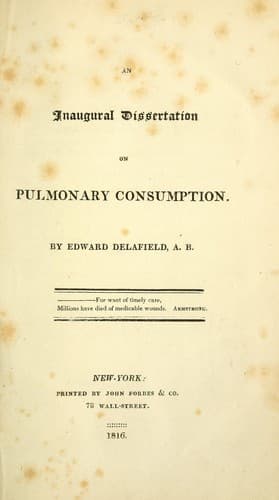
An inaugural dissertation on pulmonary consumption — John Shaqi
An inaugural dissertation on pulmonary consumptionDelafield, Edward
History
An inaugural dissertation on pulmonary consumption
Delafield, Edward
Tuberculosis
Hæmoptysis, then, I would consider, as very seldom, perhaps, never,
being the cause of Consumption; but in all those cases in which it
is assigned as the cause, merely a symptom of the incipient stage of
the disease. The symptoms accompanying hæmorrhage from the lungs, are
no other than those of incipient Phthisis. They are thus accurately
described by Dr. Reid. “When subsequent to a sense of weight and
oppression in the breast, which scarcely amounts to a feeling of pain,
together with cough, difficult respiration, and general lassitude, a
quantity of blood is suddenly, and in a convulsive manner, discharged
from the mouth, there can remain small doubt respecting the part from
which it proceeds. If the discharged blood be of a florid colour, and
together with the above symptoms, a saltish taste be perceived in the
mouth, and the patient become sensible of a degree of irritation in
the upper part of the trachea, the nature of the affection is rendered
altogether unequivocal.” Every symptom here enumerated, occurs in the
early periods of Consumption.
Nor have we any better reason for believing tubercles to be an exciting
cause of Phthisis. These appearances are indeed very frequently found
in dissections of the lungs of those who have died of Consumption.
Of the nine hundred patients examined by Bayle, 624 had tuberculated
lungs. Tubercles were formerly considered as indurated glands, and
generally attributed to a scrophulous constitution; but we are assured
by Baillie, in his morbid Anatomy, “that there is no glandular
structure in the cellular connecting membrane of the lungs; and on
the inside of the branches of the trachea, where there are follicles,
tubercles have never been seen.” These tubercles are roundish bodies,
of a firm consistence, and frequently a cartilaginous structure, but
often containing decidedly purulent matter. By the union of several
of them, vomicæ are formed, which are only larger tubercles. May not
the formation of these bodies be sufficiently accounted for by the
preceding inflammation, and they be considered therefore a consequence,
rather than a cause of Consumption? Dr. Rush insists that tubercles are
the effects, and not the cause of pulmonary Consumption; and remarks as
a farther evidence of this opinion, that similar tumours are suddenly
formed on the intestines by dysentery, and on the omentum by a yellow
fever. He refers to cases of the former in the dissections of Sir John
Pringle, and one of the latter mentioned by Dr. Mackittrick, in his
inaugural dissertation on the yellow fever, published in Edinburgh,
in the year 1776. Dr. Hosack, in his Lectures on the Theory and
Practice of Physic, advocates the same doctrine, and enforces it, by
remarking, that similar tubercles are formed in the parenchyma of
the brain, the liver, and the kidneys, in which no small glands have
yet been detected, and where, as in the lungs, there is nothing but
cellular membrane and vessels. It is his opinion, that it is an union
Public-domain text, read in full here on John Shaqi.
Reviews
Reviews
No reviews yet
Be the first to share your thoughts on this work.
Join the Discussion
Join the discussion
Sign in to leave a comment or review.
Sign InorCreate an account