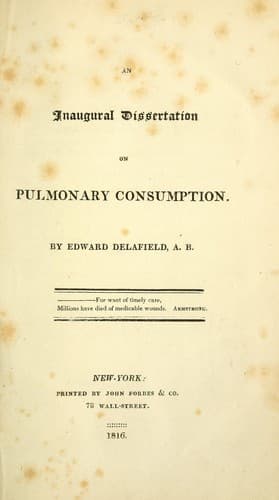
An inaugural dissertation on pulmonary consumptionDelafield, Edward
History
An inaugural dissertation on pulmonary consumption
Delafield, Edward
Tuberculosis
Agreeably to this definition, in his view of Phthisis Pulmonalis, Dr.
Cullen makes ulceration of the lungs and hectic fever essential to its
existence, and seems rather to consider the preceding symptoms a cause
of this ulceration and fever, than as constituting an integrant part of
the disease.
Nor is the place assigned by him to Phthisis Pulmonalis, in his
Nosological Arrangement, more correct than his definition of it. He
places it in the order Hæmorrhagiæ, and considers it merely as a
consequence of Hæmoptysis. Even if it were always excited by hæmorrhage
from the lungs, it would be improperly thus placed; but as that, even
by Dr. Cullen, is considered merely as one among many exciting causes,
the arrangement is altogether inadmissible. But if it be admitted,
according to the view which will be hereafter taken of Hæmoptysis in
this treatise, that it is rather a symptom than a cause of Consumption,
the propriety of another arrangement will be evident. Accordingly
Phthisis Pulmonalis is placed by Dr. Hosack, as one of the Phlegmasiæ.
This disposition appears to be the most proper that has hitherto been
suggested, and as such I shall adopt it. But before we can ascertain
the character and treatment of any diseases, it is necessary minutely
to examine their causes and symptoms.
Primary Phthisis Pulmonalis first claims our attention. Its
predisposing causes may be mostly arranged into five classes, as they
depend on organization, age, sex, occupation and climate.
Organization predisposes to Consumption, by mal-conformation of the
chest, which may be either natural or accidental; and an hereditary
internal structure not depending on the external form of the thorax.
For it is observed, that in some instances, those who have every
part of the external configuration, such as is generally attributed
to persons predisposed to Consumption, yet shall be free from this
disease; while on the other hand, some whose chests are externally
perfectly well formed, have been subject to catarrhal and inflammatory
complaints of the lungs, terminating in Phthisis. The form of chest
peculiar to many Phthisical patients, “is occasioned by the sternal
or breast-bone being pressed too much in upon the substance of the
lungs: thus the clavicles and shoulder-blades are thrust out of their
proper position, and made to assume, in some measure, the form of
wings, to which indeed they have been with propriety compared, just
raised from the body and about to expand for flight. By this internal
direction of the sternum, the full expansion and proper sweep of the
ribs is likewise prevented, and an unnatural curvature or prominence is
occasioned on either side of the breast, with a corresponding central
depression.”[4] This is the peculiar form to which the term narrow
chest is generally applied. A flattened or any other unnatural figure
of the chest may produce the same injury.
Public-domain text, read in full here on John Shaqi.
Reviews
Reviews
No reviews yet
Be the first to share your thoughts on this work.
Join the Discussion
Join the discussion
Sign in to leave a comment or review.
Sign InorCreate an account