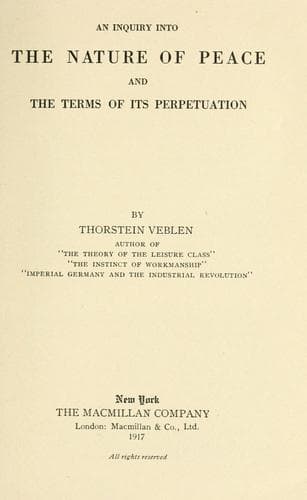
An Inquiry into the Nature of Peace and the Terms of Its PerpetuationVeblen, Thorstein
Philosophy
An Inquiry into the Nature of Peace and the Terms of Its Perpetuation
Veblen, Thorstein
Peace; World War, 1914-1918 -- Peace
On the whole, the case of China is more to the point. By and large, the
people of China, more particularly the people of the coastal-plains
region, have for long habitually lived under a regime of peace by
non-resistance. The peace has been broken transiently from time to time,
and local disturbances have not been infrequent; but, taken by and
large, the situation has habitually been of the peaceful order, on a
ground of non-resisting submission. But this submission has not commonly
been of a whole-hearted kind, and it has also commonly been associated
with a degree of persistent sabotage; which has clogged and retarded the
administration of governmental law and order, and has also been
conducive to a large measure of irresponsible official corruption. The
habitual scheme of things Chinese in this bearing may fairly be
described as a peace of non-resistance tempered with sabotage and
assassination. Such was the late Manchu regime, and there is no reason
in China for expecting a substantially different outcome from the
Japanese invasion that is now under way. The nature of this Japanese
incursion should be sufficiently plain. It is an enterprise in
statecraft after the order of Macchiavelli, Metternich, and Bismarck. Of
course, the conciliatory fables given out by the diplomatic service, and
by the other apologists, are to be taken at the normal discount of
one-hundred percent. The relatively large current output of such fables
may afford a hint as to the magnitude of the designs which the fables
are intended to cover.
The Chinese people have had a more extended experience in peace of this
order than all others, and their case should accordingly be instructive
beyond all others. Not that a European peace by non-resistance need be
expected to run very closely on the Chinese lines, but there should be
a reasonable expectation that the large course of things would be
somewhat on the same order in both cases. Neither the European
traditions and habitual temperament nor the modern state of the
industrial arts will permit one to look for anything like a close
parallel in detail; but it remains true, when all is said, that the
Chinese experience of peace under submission to alien masters affords
the most instructive illustration of such a regime, as touches its
practicability, its methods, its cultural value, and its effect on the
fortunes of the subject peoples and of their masters.
Public-domain text, read in full here on John Shaqi.
Reviews
Reviews
No reviews yet
Be the first to share your thoughts on this work.
Elsewhere in the archive
Join the Discussion
Join the discussion
Sign in to leave a comment or review.
Sign InorCreate an account