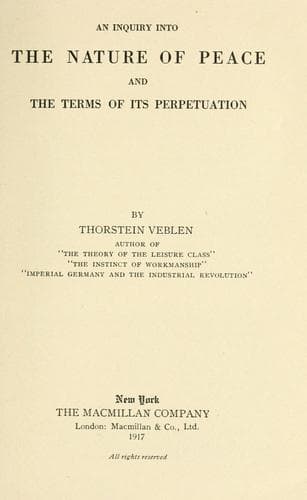
An Inquiry into the Nature of Peace and the Terms of Its PerpetuationVeblen, Thorstein
Philosophy
An Inquiry into the Nature of Peace and the Terms of Its Perpetuation
Veblen, Thorstein
Peace; World War, 1914-1918 -- Peace
It is plain, however, that the Turkish remedy for this form of
insubordination is a wasteful means of keeping the peace. Plainly, to
the home office, the High Command, the extinction of a village with its
population is a more substantial loss than the unseasonable decease of
one of its administrative agents; particularly when it is called to mind
that such a decease will presumably follow only on such profligate
excesses of naughtiness as are bound to be inexcusably unprofitable to
the central authority. It may be left an open question how far a
corrective of this nature can hopefully be looked to as applicable, in
case of need, under the projected German Imperial usufruct.
It may, I apprehend, be said without offense that there is no depth of
depravity below the ordinary reach of the Russian bureaucracy; but this
organisation finds itself constrained, after all, to use circumspection
and set some limits on individual excursions beyond the bounds of
decency and humanity, so soon as these excesses touch the common or
joint interest of the organisation. Any excess of atrocity, beyond a
certain margin of tolerance, on the part of any one of its members is
likely to work pecuniary mischief to the rest; and then, the
bureaucratic conduct of affairs is also, after all, in an uncertain
degree subject to some surveillance by popular sentiment at home or
abroad. The like appears not to hold true of the Turkish official
organisation. The difference may be due to a less provident spirit among
the latter, as already indicated. But a different tradition, perhaps an
outgrowth of this lack of providence and of the consequent growth of a
policy of "frightfulness," may also come in for a share in the outcome;
and there is also a characteristic difference in point of religious
convictions, which may go some way in the same direction. The followers
of Islam appear on the whole to take the tenets of their faith at their
face value--servile, intolerant and fanatic--whereas the Russian
official class may perhaps without undue reproach be considered to have
on the whole outlived the superstitious conceits to which they yield an
expedient _pro forma_ observance. So that when worse comes to worst, and
the Turk finds himself at length with his back against the last
consolations of the faith that makes all things straight, he has the
assured knowledge that he is in the right as against the unbelievers;
whereas the Russian bureaucrat in a like case only knows that he is in
the wrong. The last extremity is a less conclusive argument to the man
in whose apprehension it is not the last extremity. Again, there is some
shadow of doubt falls on the question as to which of these is more
nearly in the German Imperial spirit.
Public-domain text, read in full here on John Shaqi.
Reviews
Reviews
No reviews yet
Be the first to share your thoughts on this work.
Elsewhere in the archive
Join the Discussion
Join the discussion
Sign in to leave a comment or review.
Sign InorCreate an account