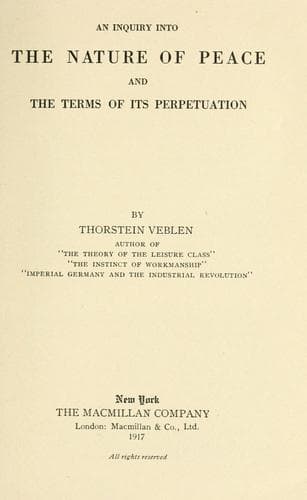
An Inquiry into the Nature of Peace and the Terms of Its PerpetuationVeblen, Thorstein
Philosophy
An Inquiry into the Nature of Peace and the Terms of Its Perpetuation
Veblen, Thorstein
Peace; World War, 1914-1918 -- Peace
Mere legal citizenship or allegiance does not decide the matter either;
at least not by any means unavoidably; as appears in the case of the
Chinese subject under Manchu or Japanese rule; and as appears perhaps
more perspicuously in the case of the "hyphenate" American citizen,
whose formal allegiance is to the nation in whose land he prefers to
live, all the while that his patriotic affection centers on his
spiritual Fatherland in whose fortunes he has none but a non-resident
interest. Indeed, the particular national tie that will bind the
affections--that is to say the effectual patriotic attachment--of any
given individual may turn out on closer scrutiny to be neither that of
domicile or of formal legal allegiance, nor that of putative origin or
pedigree, but only a reflex of certain national animosities; which may
also turn out on examination to rest on putative grounds--as illustrated
by a subsidiary class of hyphenate American citizens whose affections
have come to be bound up in the national fortunes of one foreign Power
for the simple, but sufficient, reason that, on conventional grounds,
they bear malice against another equally foreign Power.
Evidently there is much sophistication, not to say conventionalised
affectation, in all this national attachment and allegiance. It will
perhaps not do to say that it is altogether a matter of sophistication.
Yet it may not exceed the premises to say that the particular choice,
the concrete incidence, of this national attachment is in any given case
a matter of sophistication, largely tempered with fortuity. One is born
into a given nationality--or, in case of dynastic allegiance, into
service and devotion to a (fortuitously) given sovereign--or at least so
it is commonly believed. Still one can without blame, and without
excessive shame, shift one's allegiance on occasion. What is not
countenanced among civilised men is to shift out of allegiance to any
given nationality or dynasty without shifting into the like complication
of gainless obligations somewhere else. Such a shifting of national or
dynastic base is not quite reputable, though it is also not precisely
disreputable. The difficulty in the case appears to be a moral
difficulty, not a mental or a pecuniary one, and assuredly not a
physical difficulty, since the relation in question is not a physical
relation. It would appear to be of the moral order of things, in that
sense of the term in which conventional proprieties are spoken of as
moral. That is to say, it is a question of conforming to current
expectations under a code of conventional proprieties. Like much of the
conventional code of behavior this patriotic attachment has the benefit
of standardised decorum, and its outward manifestations are enjoined by
law. All of which goes to show how very seriously the whole matter is
regarded.
Public-domain text, read in full here on John Shaqi.
Reviews
Reviews
No reviews yet
Be the first to share your thoughts on this work.
Elsewhere in the archive
Join the Discussion
Join the discussion
Sign in to leave a comment or review.
Sign InorCreate an account