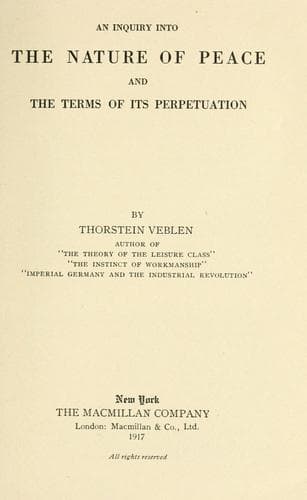
An Inquiry into the Nature of Peace and the Terms of Its PerpetuationVeblen, Thorstein
Philosophy
An Inquiry into the Nature of Peace and the Terms of Its Perpetuation
Veblen, Thorstein
Peace; World War, 1914-1918 -- Peace
And yet it is also a matter of common notoriety that large aggregates of
men, not to speak of sporadic individuals, will on occasion shift their
allegiance with the most felicitous effect and with no sensible loss of
self-respect or of their good name. Such a shift is to be seen in
multiple in the German nation within the past half-century, when, for
instance, the Hanoverians, the Saxons, and even the Holsteiners in very
appreciable numbers, not to mention the subjects of minuscular
principalities whose names have been forgotten in the shuffle, all
became good and loyal subjects of the Empire and of the Imperial
dynasty,--good and loyal without reservation, as has abundantly
appeared. So likewise within a similar period the inhabitants of the
Southern States repudiated their allegiance to the Union, putting in its
place an equivalent loyalty to their new-made country; and then, when
the new national establishment slipped out from under their feet they
returned as whole-heartedly as need be to their earlier allegiance. In
each of these moves, taken with deliberation, it is not to be doubted
that this body of citizens have been moved by an unimpeachable spirit of
patriotic honour. No one who is in any degree conversant with the facts
is likely to question the declaration that it would be a perversion, not
to say an inversion, of fact to rate their patriotic devotion to the
Union today lower than that of any other section of the country or any
other class or condition of men.
But there is more, and in a sense worse, to be found along the same
general line of evidence touching this sublimated sentiment of group
solidarity that is called nationalism. The nation, of course, is large;
the larger the better, it is believed. It is so large, indeed, that
considered as a group or community of men living together it has no
sensible degree of homogeneity in any of their material circumstances or
interests; nor is anything more than an inconsiderable fraction of the
aggregate population, territory, industry, or daily life known to any
one of these patriotic citizens except by remote and highly dubious
hearsay. The one secure point on which there is a (constructive)
uniformity is the matter of national allegiance; which grows stronger
and more confident with every increase in aggregate mass and volume. It
is also not doubtful, e.g., that if the people of the British Dominions
in North America should choose to throw in their national lot with the
Union, all sections and classes, except those whose pecuniary interest
in a protective tariff might be conceived to suffer, would presently
welcome them; nor is it doubtful that American nationality would cover
the new and larger aggregate as readily as the old. Much the same will
hold true with respect to the other countries colonised under British
auspices. And there is no conclusive reason for drawing the limit of
admissible national extension at that point.
Public-domain text, read in full here on John Shaqi.
Reviews
Reviews
No reviews yet
Be the first to share your thoughts on this work.
Elsewhere in the archive
Join the Discussion
Join the discussion
Sign in to leave a comment or review.
Sign InorCreate an account