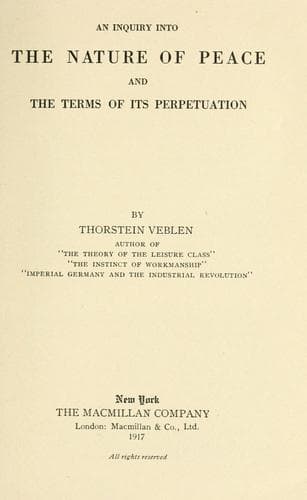
An Inquiry into the Nature of Peace and the Terms of Its PerpetuationVeblen, Thorstein
Philosophy
An Inquiry into the Nature of Peace and the Terms of Its Perpetuation
Veblen, Thorstein
Peace; World War, 1914-1918 -- Peace
So far the argument has run on the pecuniary incidence of this projected
Imperial dominion as it falls on the underlying community as a whole,
with no attempt to discriminate between the divergent interests of the
different classes and conditions of men that go to make up any modern
community. The question in hand is a question of pecuniary burdens, and
therefore of the pecuniary interests of these several distinguishable
classes or conditions of men. In all these modern nations that now stand
in the article of decision between peace by submission or a doubtful and
melancholy alternative,--in all of them men are by statute and custom
inviolably equal before the law, of course; they are ungraded and
masterless men before the law. But these same peoples are also alike in
the respect that pecuniary duties and obligations among them are
similarly sacred and inviolable under the dispassionate findings of the
law. This pecuniary equality is, in effect, an impersonal equality
between pecuniary magnitudes; from which it follows that these citizens
of the advanced nations are not ungraded men in the pecuniary respect;
nor are they masterless, in so far as a greater pecuniary force will
always, under this impersonal equality of the law, stand in a relation
of mastery toward a lesser one.
Class distinctions, except pecuniary distinctions, have fallen away. But
all these modern nations are made up of pecuniary classes, differing
from one another by minute gradations in the marginal cases, but
falling, after all, and in the large, into two broadly and securely
distinguishable pecuniary categories: those who have more and those who
have less. Statisticians have been at pains to ascertain that a
relatively very small numerical minority of the citizens in these modern
nations own all but a relatively very small proportion of the aggregate
wealth in the country. So that it appears quite safe to say that in such
a country as America, e.g., something less than ten percent of the
inhabitants own something more than ninety percent of the country's
wealth. It would scarcely be a wild overstraining of its practical
meaning to say that this population is made up of two classes: those who
own the country's wealth, and those who do not. In strict accuracy, as
before the law, this characterisation will not hold; whereas in
practical effect, it is a sufficiently close approximation. This latter
class, who have substantially no other than a fancied pecuniary interest
in the nation's material fortunes, are the category often spoken of as
The Common Man. It is not necessary, nor is it desired, to find a
corresponding designation for the other category, those who own.
Public-domain text, read in full here on John Shaqi.
Reviews
Reviews
No reviews yet
Be the first to share your thoughts on this work.
Elsewhere in the archive
Join the Discussion
Join the discussion
Sign in to leave a comment or review.
Sign InorCreate an account