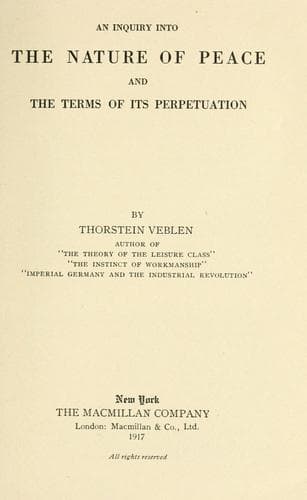
An Inquiry into the Nature of Peace and the Terms of Its PerpetuationVeblen, Thorstein
Philosophy
An Inquiry into the Nature of Peace and the Terms of Its Perpetuation
Veblen, Thorstein
Peace; World War, 1914-1918 -- Peace
The articulate recognition of this division into contrasted pecuniary
classes or conditions, with correspondingly (at least potentially)
divergent pecuniary interests, need imply no degree of approval or
disapproval of the arrangement which is so recognised. The recognition
of it is necessary to a perspicuous control of the argument, as bears on
the possible systematic and inherent discrepancy among these men in
respect of their material interests under the projected Imperial rule.
Substantially, it is a distinction between those who have and those who
have not, and in a question of prospective pecuniary loss the man who
has nothing to lose is differently placed from the one who has. It would
perhaps seem flippant, and possibly lacking in the courtesy due one's
prospective lord paramount, to say with the poet, _Cantabit vacuus coram
latrone viator_.
But the whole case is not so simple. It is only so long as the projected
pecuniary inroad is conceived as a simple sequestration of wealth in
hand, that such a characterisation can be made to serve. The Imperial
aim is not a passing act of pillage, but a perpetual usufruct; and the
whole question takes on a different and more complex shape when it so
touches the enduring conditions of life and livelihood. The citizen who
has nothing, or who has no capitalisable source of unearned income, yet
has a pecuniary interest in a livelihood to be gained from day to day,
and he is yet vulnerable in the pecuniary respect in that his livelihood
may with the utmost facility be laid under contribution by various and
sundry well-tried contrivances. Indeed, the common man who depends for
his livelihood on his daily earnings is in a more immediately
precarious position than those who have something appreciable laid up
against a rainy day, in the shape of a capitalised source of income.
Only that it is still doubtful if his position is precarious in such a
fashion as to lay him open to a notable increase of hardship, or to loss
of the amenities of life, in the same relative degree as his well-to-do
neighbour.
In point of fact it may well be doubted if this common man has anything
to apprehend in the way of added hardship or loss of creature comforts
under the contemplated regime of Imperial tutelage. He would presumably
find himself in a precarious case under the arbitrary and irresponsible
authority of an alien master working through an alien master class. The
doubt which presents itself is as to whether this common man would be
more precariously placed, or would come in for a larger and surer sum of
hard usage and scant living, under this projected order of things, than
what he already is exposed to in his pecuniary relations with his
well-to-do compatriots under the current system of law and order.
Public-domain text, read in full here on John Shaqi.
Reviews
Reviews
No reviews yet
Be the first to share your thoughts on this work.
Elsewhere in the archive
Join the Discussion
Join the discussion
Sign in to leave a comment or review.
Sign InorCreate an account