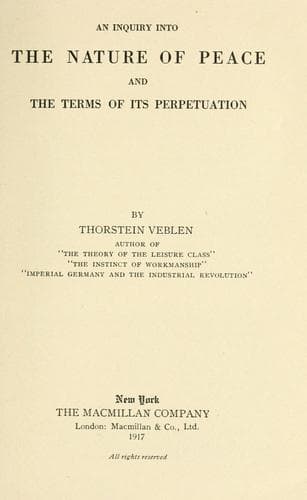
An Inquiry into the Nature of Peace and the Terms of Its PerpetuationVeblen, Thorstein
Philosophy
An Inquiry into the Nature of Peace and the Terms of Its Perpetuation
Veblen, Thorstein
Peace; World War, 1914-1918 -- Peace
National surveillance and regulation of business traffic in these
countries hitherto, ever since and in so far as the modern democratic
order of things has taken effect, has uniformly been of the nature of
interference with trade and investment in behalf of the nation's
mercantile community at large, as seen in port and shipping regulations
and in the consular service, or in behalf of particular favored groups
or classes of business concerns, as in protective tariffs and subsidies.
In all this national management of pecuniary affairs, under modern
democratic principles, the common man comes into the case only as raw
material of business traffic,--as consumer or as laborer. He is one of
the industrial agencies by use of which the businessman who employs him
supplies himself with goods for the market, or he is one of the units
of consumptive demand that make up this market in which the business man
sells his goods, and so "realises" on his investment. He is, of course,
free, under modern principles of the democratic order, to deal or not to
deal with this business community, whether as laborer or as consumer, or
as small-scale producer engaged in purveying materials or services on
terms defined by the community of business interests engaged on so large
a scale as to count in their determination. That is to say, he is free
_de jure_ to take or leave the terms offered. _De facto_ he is only free
to take them--with inconsequential exceptions--the alternative being
obsolescence by disuse, not to choose a harsher name for a distasteful
eventuality.
The general ground on which the business system, as it works under the
over-ruling exigencies of the so-called "big business," so defines the
terms of life for the common man, who works and buys, is the ground
afforded by the principle of "charging what the traffic will bear;" that
is to say, fixing the terms of hiring, buying and selling at such a
figure as will yield the largest net return to the business concerns in
whom, collectively or in severalty, the discretion vests. Discretion in
these premises does not vest in any business concern that does not
articulate with the system of "big business," or that does not dispose
of resources sufficient to make it a formidable member of the system.
Whether these concerns act in severalty or by collusion and conspiracy,
in so defining the pecuniary terms of life for the community at large,
is substantially an idle question, so far as bears on the material
interest of the common man. The base-line is still what the traffic will
bear, and it is still adhered to, so nearly as the human infirmity of
the discretionary captains of industry will admit, whether the due
approximation to this base-line is reached by a process of competitive
bidding or by collusive advisement.
Public-domain text, read in full here on John Shaqi.
Reviews
Reviews
No reviews yet
Be the first to share your thoughts on this work.
Elsewhere in the archive
Join the Discussion
Join the discussion
Sign in to leave a comment or review.
Sign InorCreate an account