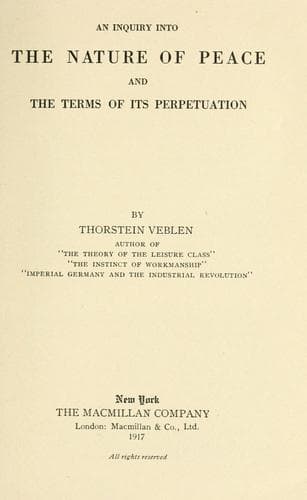
An Inquiry into the Nature of Peace and the Terms of Its PerpetuationVeblen, Thorstein
Philosophy
An Inquiry into the Nature of Peace and the Terms of Its Perpetuation
Veblen, Thorstein
Peace; World War, 1914-1918 -- Peace
Being a pecuniary majority--what may be called a majority of the
corporate stock--of the nation, it is also fundamentally and eternally
right and good that the pecuniary interests of the owners of the
material means of life should rule unabated in all those matters of
public policy that touch on the material fortunes of the community at
large. Barring a slight and intermittent mutter of discontent, this
arrangement has also the cordial approval of popular sentiment in these
modern democratic nations. One need only recall the paramount importance
which is popularly attached to the maintenance and extension of the
nation's trade--for the use of the investors--or the perpetuation of a
protective tariff--for the use of the protected business concerns--or,
again, the scrupulous regard with which such a body of public servants
as the Interstate Commerce Commission will safeguard the legitimate
claim of the railway companies to a "reasonable" rate of earnings on the
capitalised value of the presumed earning-capacity of their property.
* * * * *
Again, in view of the unaccustomed freedom with which it is here
necessary to speak of these delicate matters, it may be in place to
disclaim all intention to criticise the established arrangements on
their merits as details of public policy. All that comes in question
here, touching these and the like features of the established law and
order, is the bearing of all this on the material fortunes of the common
man under the current regime, as contrasted with what he would
reasonably have to look for under the projected regime of Imperial
tutelage that would come in, consequent upon this national surrender to
Imperial dominion.
* * * * *
In these democratic countries public policy is guided primarily by
considerations of business expediency, and the administration, as well
as the legislative power, is in the hands of businessmen, chosen
avowedly on the ground of their businesslike principles and ability.
There is no power in such a community that can over-rule the exigencies
of business, nor would popular sentiment countenance any exercise of
power that should traverse these exigencies, or that would act to
restrain trade or discourage the pursuit of gain. An apparent exception
to the rule occurs in wartime, when military exigencies may over-rule
the current demands of business traffic; but the exception is in great
part only apparent, in that the warlike operations are undertaken in
whole or in part with a view to the protection or extension of business
traffic.
Public-domain text, read in full here on John Shaqi.
Reviews
Reviews
No reviews yet
Be the first to share your thoughts on this work.
Elsewhere in the archive
Join the Discussion
Join the discussion
Sign in to leave a comment or review.
Sign InorCreate an account