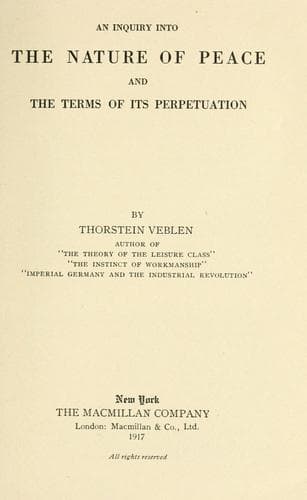
An Inquiry into the Nature of Peace and the Terms of Its PerpetuationVeblen, Thorstein
Philosophy
An Inquiry into the Nature of Peace and the Terms of Its Perpetuation
Veblen, Thorstein
Peace; World War, 1914-1918 -- Peace
On the opposite side of the account, it is also worth noting that, while
modern business management may now and again fall short of what the
traffic will bear, it happens more commonly that its exactions will
exceed that limit. This will particularly be true in businessmen's
dealings with hired labour, as also and perhaps with equally
far-reaching consequences in an excessive recourse to sophistications
and adulterants and an excessively parsimonious provision for the
safety, health or comfort of their customers--as, e.g., in passenger
traffic by rail, water or tramway. The discrepancy to which attention is
invited here is due to a discrepancy between business expediency, that
is expediency for the purpose of gain by a given businessman, on the one
hand, and serviceability to the common good, on the other hand. The
business concern's interest in the traffic in which it engages is a
short-term interest, or an interest in the short-term returns, as
contrasted with the long-term or enduring interest which the community
at large has in the public service over which any such given business
concern disposes. The business incentive is that afforded by the
prospective net pecuniary gain from the traffic, substantially an
interest in profitable sales; while the community at large, or the
common man that goes to make up such a community, has a material
interest in this traffic only as regards the services rendered and the
enduring effects that follow from it.
The businessman has not, or at least is commonly not influenced by, any
interest in the ulterior consequences of the transactions in which he
is immediately engaged. This appears to hold true in an accentuated
degree in the domain of that large-scale business that draws its gains
from the large-scale modern industry and is managed on the modern
footing of corporation finance. This modern fashion of business
organisation and management apparently has led to a substantial
shortening of the term over which any given investor maintains an
effective interest in any given corporate enterprise, in which his
investments may be placed for the time being. With the current practice
of organising industrial and mercantile enterprises on a basis of
vendible securities, and with the nearly complete exemption from
personal responsibility and enduring personal attachment to any one
corporate enterprise which this financial expedient has brought, it has
come about that in the common run of cases the investor, as well as the
directorate, in any given enterprise, has an interest only for the time
being. The average term over which it is (pecuniarily) incumbent on the
modern businessman to take account of the working of any given
enterprise has shortened so far that the old-fashioned accountability,
that once was depended on to dictate a sane and considerate management
with a view to permanent good-will, has in great measure become
inoperative.
Public-domain text, read in full here on John Shaqi.
Reviews
Reviews
No reviews yet
Be the first to share your thoughts on this work.
Elsewhere in the archive
Join the Discussion
Join the discussion
Sign in to leave a comment or review.
Sign InorCreate an account