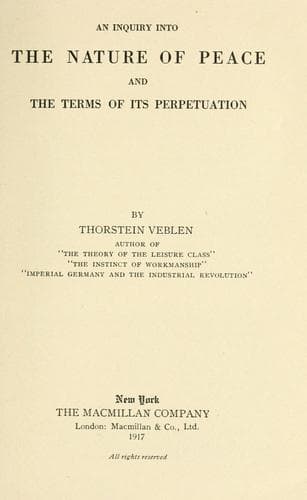
An Inquiry into the Nature of Peace and the Terms of Its PerpetuationVeblen, Thorstein
Philosophy
An Inquiry into the Nature of Peace and the Terms of Its Perpetuation
Veblen, Thorstein
Peace; World War, 1914-1918 -- Peace
By and large, it seems unavoidable that the pecuniary interests of the
businessmen on the one hand and the material interests of the community
on the other hand are diverging in a more and more pronounced degree,
due to institutional circumstances over which no prompt control can be
had without immediate violation of that scheme of personal rights in
which the constitution of modern democratic society is grounded. The
quandary in which these communities find themselves, as an outcome of
their entrance upon "the simple and obvious system of Natural Liberty,"
is shown in a large and instructive way by what is called "labor
trouble," and in a more recondite but no less convincing fashion by the
fortunes of the individual workman under the modern system.
The cost of production of a modern workman has constantly increased,
with the advance of the industrial arts. The period of preparation, of
education and training, necessary to turn out competent workmen, has
been increasing; and the period of full workmanlike efficiency has been
shortening, in those industries that employ the delicate and exacting
processes of the modern technology. The shortening of this working-life
of the workman is due both to a lengthening of the necessary period of
preparation, and to the demand of these processes for so full a use of
the workman's forces that even the beginning of senescence will count as
a serious disability,--in many occupations as a fatal disability. It is
also a well ascertained fact that effectual old age will be brought on
at an earlier period by overwork; overwork shortens the working
life-time of the workman. Thorough speeding-up ("Scientific
Management"?) will unduly shorten this working life-time, and so it may,
somewhat readily, result in an uneconomical consumption of the
community's man-power, by consuming the workmen at a higher rate of
speed, a higher pressure, with a more rapid rate of deterioration, than
would give the largest net output of product per unit of man-power
available, or per unit of cost of production of such man-power.
Public-domain text, read in full here on John Shaqi.
Reviews
Reviews
No reviews yet
Be the first to share your thoughts on this work.
Elsewhere in the archive
Join the Discussion
Join the discussion
Sign in to leave a comment or review.
Sign InorCreate an account