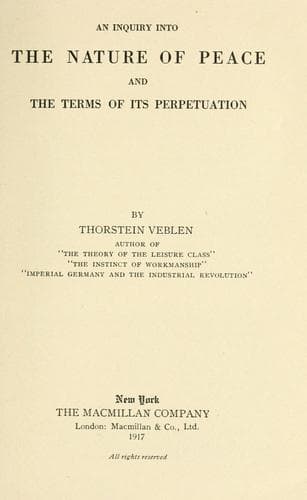
An Inquiry into the Nature of Peace and the Terms of Its PerpetuationVeblen, Thorstein
Philosophy
An Inquiry into the Nature of Peace and the Terms of Its Perpetuation
Veblen, Thorstein
Peace; World War, 1914-1918 -- Peace
On this head the guiding incentives of the businessman and the material
interest of the community at large--not to speak of the selfish interest
of the individual workman--are systematically at variance. The cost of
production of workmen does not fall on the business concern which
employs them, at least not in such definite fashion as to make it appear
that the given business concern or businessman has a material interest
in the economical consumption of the man-power embodied in this given
body of employees. Some slight and exceptional qualification of this
statement is to be noted, in those cases where the processes in use are
such as to require special training, not to be had except by a working
habituation to these processes in the particular industrial plant in
question. So far as such special training, to be had only as employees
of the given concern, is a necessary part of the workman's equipment for
this particular work, so far the given employer bears a share and an
interest in the cost of production of the workmen employed; and so far,
therefore, the employer has also a pecuniary interest in the economical
use of his employees; which usually shows itself in the way of some
special precautions being taken to prevent the departure of these
workmen so long as there is a clear pecuniary loss involved in replacing
them with men who have not yet had the special training required.
Evidently this qualifying consideration covers no great proportion of
the aggregate man-power consumed in industrial enterprises under
business management. And apart from the instances, essentially
exceptional, where such a special consideration comes in, the
businessmen in charge will, quite excusably as things go, endeavour to
consume the man-power of which they dispose in the persons of their
employees, not at the rate that would be most economical to the
community at large, in view of the cost of their replacement, nor at
such a rate as would best suit the taste or the viability of the
particular workman, but at such a rate as will yield the largest net
pecuniary gain to the employer.
There is on record an illustrative, and indeed an illustrious, instance
of such cannily gainful consumption of man-power carried out
systematically and with consistently profitable effect in one of the
staple industries of the country. In this typical, though exceptionally
thoroughgoing and lucrative enterprise, the set rule of the management
was, to employ none but select workmen, in each respective line of work;
to procure such select workmen and retain them by offering wages
slightly over the ordinary standard; to work them at the highest pace
and pressure attainable with such a picked body; and to discharge them
on the first appearance of aging or of failing powers. In the rules of
the management was also included the negative proviso that the concern
assumed no responsibility for the subsequent fortunes of discharged
workmen, in the way of pension, insurance or the like.
Public-domain text, read in full here on John Shaqi.
Reviews
Reviews
No reviews yet
Be the first to share your thoughts on this work.
Elsewhere in the archive
Join the Discussion
Join the discussion
Sign in to leave a comment or review.
Sign InorCreate an account