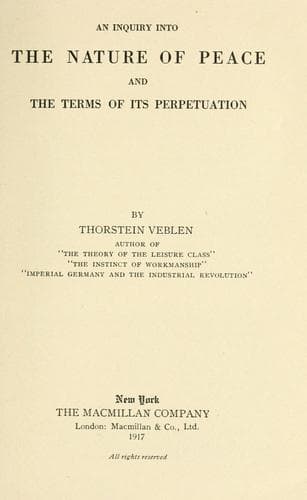
An Inquiry into the Nature of Peace and the Terms of Its PerpetuationVeblen, Thorstein
Philosophy
An Inquiry into the Nature of Peace and the Terms of Its Perpetuation
Veblen, Thorstein
Peace; World War, 1914-1918 -- Peace
The point in speaking of this contingent whose place in the economy of
human affairs it is to consume, or to own, or to pursue a margin of
profit, is simply that of contrasting this composite human contingent
with the common man; whose numbers account for some nine-tenths or more
of the community, while his class accounts for something less than
one-tenth of the invested wealth, and appreciably less than that
proportion of the discretionary national establishment,--the government,
national or local, courts, attorneys, civil service, diplomatic and
consular, military and naval. The arrangement may be called a
gentlemen's government, if one would rather have it that way; but a
gentleman is necessarily one who lives on free income from invested
wealth--without such a source of free, that is to say unearned, income
he becomes a decayed gentleman. Again, pushing the phrasing back a step
farther toward the ground facts, there are those who would speak of the
current establishments as "capitalistic;" but this term is out of line
in that it fails to touch the human element in the case, and
institutions, such as governmental establishments and their functioning,
are after all nothing but the accustomed ways and means of human
behaviour; so that "capitalistic" becomes a synonym for "businessmen's"
government so soon as it is designated in terms of the driving
incentives and the personnel. It is an organisation had with a view to
the needs of business (i.e. pecuniary) enterprise, and is made up of
businessmen and gentlemen, which comes to much the same, since a
gentleman is only a businessman in the second or some later generation.
Except for the slightly odious suggestion carried by the phrase, one
might aptly say that the gentleman, in this bearing, is only a
businessman gone to seed.
By and large, and taking the matter naively at the simple face value of
the material gain or loss involved, it should seem something of an idle
question to the common man whether his collective affairs are to be
managed by a home-bred line of businessmen and their successive filial
generations of gentlemen, with a view to accelerate the velocity and
increase the volume of competitive gain and competitive spending, on
the one hand, or by an alien line of officials, equally aloof from his
common interests, and managing affairs with a view to the usufruct of
his productive powers in furtherance of the Imperial dominion.
Public-domain text, read in full here on John Shaqi.
Reviews
Reviews
No reviews yet
Be the first to share your thoughts on this work.
Elsewhere in the archive
Join the Discussion
Join the discussion
Sign in to leave a comment or review.
Sign InorCreate an account