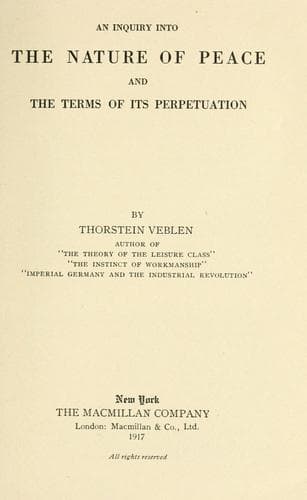
An Inquiry into the Nature of Peace and the Terms of Its PerpetuationVeblen, Thorstein
Philosophy
An Inquiry into the Nature of Peace and the Terms of Its Perpetuation
Veblen, Thorstein
Peace; World War, 1914-1918 -- Peace
Not that the good faith or the generous intentions of these governments
of gentlemen is questioned or is in any degree questionable; what is
here spoken of is only the practical effect of the policies which they
pursue, doubtless with benevolent intentions and well-placed
complacency. In effect, things being as they are today in the civilised
world's industry and trade, it happens, as in some sort an unintended
but all-inclusive accident, that the guidance of affairs by business
principles works at cross purposes with the material interests of the
common man.
So ungraceful a view of the sacred core of this modern democratic
organisation will need whatever evidence can be cited to keep it in
countenance. Therefore indulgence is desired for one further count in
this distasteful recital of ineptitudes inherent in this institutional
scheme of civilised life. This count comes under the head of what may be
called capitalistic sabotage. "Sabotage" is employed to designate a
wilful retardation, interruption or obstruction of industry by
peaceable, and ordinarily by legally defensible, measures. In its
present application, particularly, there is no design to let the term
denote or insinuate a recourse to any expedients or any line of conduct
that is in any degree legally dubious, or that is even of questionable
legitimacy.
Sabotage so understood, as not comprising recourse to force or fraud, is
a necessary and staple expedient of business management, and its
employment is grounded in the elementary and indefeasible rights of
ownership. It is simply that the businessman, like any other owner, is
vested with the right freely to use or not to use his property for any
given purpose. His decision, for reasons of his own, not to employ the
property at his disposal in a particular way at a particular time, is
well and blamelessly within his legitimate discretion, under the rights
of property as universally accepted and defended by modern nations. In
the particular instance of the American nation he is protected in this
right by a constitutional provision that he must not be deprived of his
property without due process of law. When the property at his disposal
is in the shape of industrial plant or industrial material, means of
transportation or stock of goods awaiting distribution, then his
decision not to employ this property, or to limit its use to something
less than full capacity, in the way for which it is adapted, becomes
sabotage, normally and with negligible exceptions. In so doing he
hinders, retards or obstructs the working of the country's industrial
forces by so much. It is a matter of course and of absolute necessity to
the conduct of business, that any discretionary businessman must be free
to deal or not to deal in any given case; to limit or to withhold the
equipment under his control, without reservation. Business discretion
and business strategy, in fact, has no other means by which to work out
its aims.
Public-domain text, read in full here on John Shaqi.
Reviews
Reviews
No reviews yet
Be the first to share your thoughts on this work.
Elsewhere in the archive
Join the Discussion
Join the discussion
Sign in to leave a comment or review.
Sign InorCreate an account