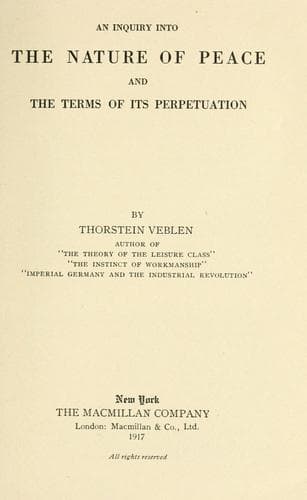
An Inquiry into the Nature of Peace and the Terms of Its PerpetuationVeblen, Thorstein
Philosophy
An Inquiry into the Nature of Peace and the Terms of Its Perpetuation
Veblen, Thorstein
Peace; World War, 1914-1918 -- Peace
A conservative estimate of this one item of capitalistic sabotage could
scarcely appraise it at less than a twenty-five percent reduction from
the normally possible productive capacity of the community, at an
average over any considerable period; and a somewhat thorough review of
the pertinent facts would probably persuade any impartial observer that,
one year with another, such businesslike enforced idleness of plant and
personnel lowers the actual output of the country's industry by
something nearer fifty percent of its ordinary capacity when fully
employed. To many, such an assertion may seem extravagant, but with
further reflection on the well-known facts in the case it will seem less
so in proportion as the unfamiliarity of it wears off.
However, the point of attention in the case is not the precise, nor the
approximate, percentages of this arrest and retardation, this partial
neutralisation of modern improvements in the industrial arts; it is only
the notorious fact that such arrest occurs, systematically and
advisedly, under the rule of business exigencies, and that there is no
corrective to be found for it that will comport with those fundamental
articles of the democratic faith on which the businessmen necessarily
proceed. Any effectual corrective would break the framework of
democratic law and order, since it would have to traverse the
inalienable right of men who are born free and equal, each freely to
deal or not to deal in any pecuniary conjuncture that arises.
But it is at the same time plain enough that this, in the larger sense
untoward, discrepancy between productive capacity and current productive
output can readily be corrected, in some appreciable degree at least, by
any sufficient authority that shall undertake to control the country's
industrial forces without regard to pecuniary profit and loss. Any
authority competent to take over the control and regulate the conduct of
the community's industry with a view to maximum output as counted by
weight and tale, rather than by net aggregate price-income over
price-cost, can readily effect an appreciable increase in the effectual
productive capacity; but it can be done only by violating that
democratic order of things within which business enterprise runs. The
several belligerent nations of Europe are showing that it can be done,
that the sabotage of business enterprise can be put aside by
sufficiently heroic measures. And they are also showing that they are
all aware, and have always been aware, that the conduct of industry on
business principles is incompetent to bring the largest practicable
output of goods and services; incompetent to such a degree, indeed, as
not to be tolerable in a season of desperate need, when the nation
requires the full use of its productive forces, equipment and man-power,
regardless of the pecuniary claims of individuals.
* * * * *
Public-domain text, read in full here on John Shaqi.
Reviews
Reviews
No reviews yet
Be the first to share your thoughts on this work.
Elsewhere in the archive
Join the Discussion
Join the discussion
Sign in to leave a comment or review.
Sign InorCreate an account