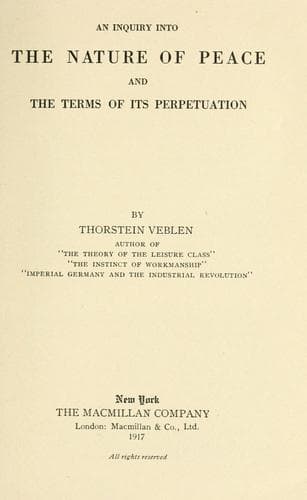
An Inquiry into the Nature of Peace and the Terms of Its PerpetuationVeblen, Thorstein
Philosophy
An Inquiry into the Nature of Peace and the Terms of Its Perpetuation
Veblen, Thorstein
Peace; World War, 1914-1918 -- Peace
Now, the projected Imperial dominion is a power of the character
required to bring a sufficient corrective to bear, in case of need, on
this democratic situation in which the businessmen in charge necessarily
manage the country's industry at cross purposes with the
community's--that is the common man's--material interest. It is an
extraneous power, to whom the continued pecuniary gain of these nations'
businessmen is a minor consideration, a negligible consideration in case
it shall appear that the Imperial usufruct of the underlying nation's
productive forces is in any degree impaired by the businessmen's
management of it for their own net gain. It is difficult to see on what
grounds of self-interest such an Imperial government could consent to
tolerate the continued management of these underlying nations'
industries on business principles, that is to say on the principle of
the maximum pecuniary gain to the businesslike managers; and recent
experience seems to teach that no excessive, that is to say no
inconvenient, degree of consideration for vested rights, and the like,
would long embarrass the Imperial government in its administration of
its usufruct.
It should be a reasonable expectation that, without malice and with an
unprejudiced view to its own usufruct of these underlying countries, the
Imperial establishment would take due care that no systematically, and
in its view gratuitously, uneconomical methods should continue in the
ordinary conduct of their industry. Among other considerations of weight
in this connection is the fact that a contented, well-fed, and not
wantonly over-worked populace is a valuable asset in such a case.
Similarly, by contraries, as an asset in usufruct to such an alien
power, a large, wealthy, spendthrift, body of gentlefolk, held in high
esteem by the common people, would have but a slight value, conceivably
even a negative value, in such a case. A wise administration would
presumably look to their abatement, rather than otherwise. At this point
the material interest of the common man would seem to coincide with that
of the Imperial establishment. Still, his preconceived notions of the
wisdom and beneficence of his gentlefolk would presumably hinder his
seeing the matter in that reasonable light.
Public-domain text, read in full here on John Shaqi.
Reviews
Reviews
No reviews yet
Be the first to share your thoughts on this work.
Elsewhere in the archive
Join the Discussion
Join the discussion
Sign in to leave a comment or review.
Sign InorCreate an account