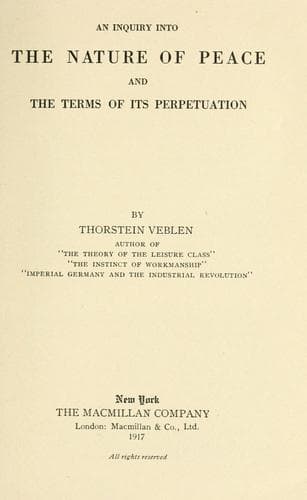
An Inquiry into the Nature of Peace and the Terms of Its PerpetuationVeblen, Thorstein
Philosophy
An Inquiry into the Nature of Peace and the Terms of Its Perpetuation
Veblen, Thorstein
Peace; World War, 1914-1918 -- Peace
Just what will be the nature and the concrete expression of these ideal
aspirations that move the common run is a matter of habitual
preconceptions; and habits of thought vary from one people to another
according to the diversity of experience to which they have been
exposed. Among the Western nations the national prestige has come to
seem worth while as an ulterior end, perhaps beyond all else that is
comprised in the secular scheme of things desirable to be had or to be
achieved. And in the apprehension of such of them as have best preserved
the habits of thought induced by a long experience in feudal subjection,
the service of the sovereign or the dynasty still stands over as the
substantial core of the cultural scheme, upon which sentiment and
endeavour converge. In the past ages of the democratic peoples, as well
as in the present-day use and wont among subjects of the dynastic
States--as e.g., Japan or Germany--men are known to have resolutely
risked, and lost, their life for the sake of the sovereign's renown, or
even to save the sovereign's life; whereas, of course, even the
slightest and most nebulous reflection would make it manifest that in
point of net material utility the sovereign's decease is an idle matter
as compared with the loss of an able-bodied workman. The sovereign may
always be replaced, with some prospect of public advantage, or failing
that, it should be remarked that a regency or inter-regnum will commonly
be a season of relatively economical administration. Again, religious
enthusiasm, and the furtherance of religious propaganda, may come to
serve the same general purpose as these secular ideals, and will perhaps
serve it just as well. Certain "principles," of personal liberty and of
opportunity for creative self-direction and an intellectually worthy
life, perhaps may also become the idols of the people, for which they
will then be willing to risk their material fortune; and where this has
happened, as among the democratic peoples of Christendom, it is not
selfishly for their own personal opportunity to live untroubled under
the light of these high principles that these opinionated men are ready
to contend, but rather impersonally for the human right which under
these principles is the due of all mankind, and particularly of the
incoming and of later generations.
Public-domain text, read in full here on John Shaqi.
Reviews
Reviews
No reviews yet
Be the first to share your thoughts on this work.
Elsewhere in the archive
Join the Discussion
Join the discussion
Sign in to leave a comment or review.
Sign InorCreate an account