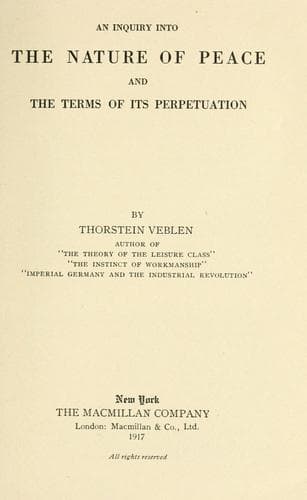
An Inquiry into the Nature of Peace and the Terms of Its PerpetuationVeblen, Thorstein
Philosophy
An Inquiry into the Nature of Peace and the Terms of Its Perpetuation
Veblen, Thorstein
Peace; World War, 1914-1918 -- Peace
On these and the like intangible ends the common man is set with such
inveterate predilection that he will, on provocation, stick at nothing
to put the project through. For such like ends the common man will lay
down his life; at least, so they say. There may always be something of
rhetorical affectation in it all; but, after all, there is sufficient
evidence to hand of such substance and tenacity in the common man's hold
on these ideal aspirations, on these idols of his human spirit, as to
warrant the assertion that he is, rather commonly, prepared to go to
greater lengths in the furtherance of these immaterial gains that are to
inure to someone else than for any personal end of his own, in the way
of creature comforts or even of personal renown.
For such ends the common man, in democratic Christendom is, on
provocation, willing to die; or again, the patient and perhaps more
far-seeing common man of pagan China is willing to live for these idols
of an inveterate fancy, through endless contumely and hard usage. The
conventional Chinese preconceptions, in the way of things that are worth
while in their own right, appear to differ from those current in the
Occident in such a way that the preconceived ideal is not to be realised
except by way of continued life. The common man's accountability to the
cause of humanity, in China, is of so intimately personal a character
that he can meet it only by tenaciously holding his place in the
sequence of generations; whereas among the peoples of Christendom there
has arisen out of their contentious past a preconception to the effect
that this human duty to mankind is of the nature of a debt, which can be
cancelled by bankruptcy proceedings, so that the man who unprofitably
dies fighting for the cause has thereby constructively paid the
reckoning in full.
Evidently, if the common man of these modern nations that are
prospectively to be brought under tutelage of the Imperial government
could be brought to the frame of mind that is habitual with his Chinese
counterpart, there should be a fair hope that pacific counsels would
prevail and that Christendom would so come in for a regime of peace by
submission under this Imperial tutelage. But there are always these
preconceptions of self-will and insubordination to be counted with
among these nations, and there is the ancient habit of a contentious
national solidarity in defense of the nation's prestige, more urgent
among these peoples than any sentiment of solidarity with mankind at
large, or any ulterior gain in civilisation that might come of continued
discipline in the virtues of patience and diligence under distasteful
circumstances.
Public-domain text, read in full here on John Shaqi.
Reviews
Reviews
No reviews yet
Be the first to share your thoughts on this work.
Elsewhere in the archive
Join the Discussion
Join the discussion
Sign in to leave a comment or review.
Sign InorCreate an account