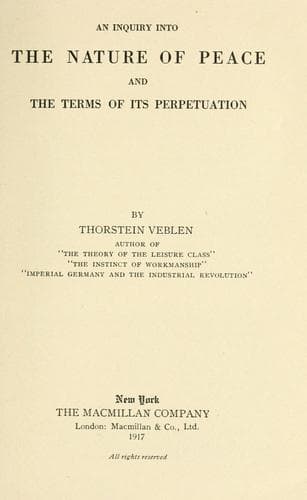
An Inquiry into the Nature of Peace and the Terms of Its PerpetuationVeblen, Thorstein
Philosophy
An Inquiry into the Nature of Peace and the Terms of Its Perpetuation
Veblen, Thorstein
Peace; World War, 1914-1918 -- Peace
The occidental conception of manhood is in some considerable measure
drawn in negative terms. So much so that whenever a question of the
manly virtues comes under controversy it presently appears that at least
the indispensable minimum, and indeed the ordinary marginal modicum, of
what is requisite to a worthy manner of life is habitually formulated in
terms of what not. This appearance is doubtless misleading if taken
without the universally understood postulate on the basis of which
negative demands are formulated. There is a good deal of what would be
called historical accident in all this. The indispensable demands of
this modern manhood take the form of refusal to obey extraneous
authority on compulsion; of exemption from coercive direction and
subservience; of insubordination, in short. But it is always understood
as a matter of course that this insubordination is a refusal to submit
to irresponsible or autocratic rule. Stated from the positive side it
would be freedom from restraint by or obedience to any authority not
constituted by express advice and consent of the governed. And as near
as it may be formulated, when reduced to the irreducible minimum of
concrete proviso, this is the final substance of things which neither
shame nor honour will permit the modern civilised man to yield. To no
arrangement for the abrogation of this minimum of free initiative and
self-direction will he consent to be a party, whether it touches the
conditions of life for his own people who are to come after, or as
touches the fortunes of such aliens as are of a like mind on this head
and are unable to make head against invasion of these human rights from
outside.
As has just been remarked, the negative form so often taken by these
demands is something of an historical accident, due to the fact that
these modern peoples came into their highly esteemed system of Natural
Liberty out of an earlier system of positive checks on self-direction
and initiative; a system, in effect, very much after the fashion of that
Imperial jurisdiction that still prevails in the dynastic States--as,
e.g., Germany or Japan--whose projected dominion is now the immediate
object of apprehension and repugnance. How naively the negative
formulation gained acceptance, and at the same time how intrinsic to the
new dispensation was the aspiration for free initiative, appears in the
confident assertion of its most genial spokesman, that when these
positive checks are taken away, "The simple and obvious system of
Natural Liberty establishes itself of its own accord."
Public-domain text, read in full here on John Shaqi.
Reviews
Reviews
No reviews yet
Be the first to share your thoughts on this work.
Elsewhere in the archive
Join the Discussion
Join the discussion
Sign in to leave a comment or review.
Sign InorCreate an account