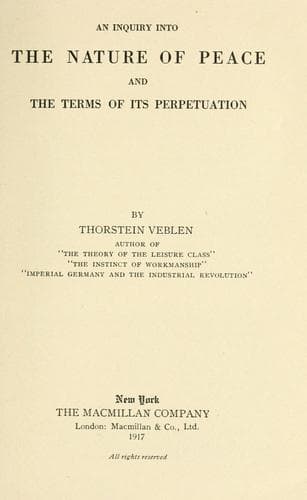
An Inquiry into the Nature of Peace and the Terms of Its PerpetuationVeblen, Thorstein
Philosophy
An Inquiry into the Nature of Peace and the Terms of Its Perpetuation
Veblen, Thorstein
Peace; World War, 1914-1918 -- Peace
Experience teaches that warlike enterprise on a moderate scale and as a
side interest is by no means incompatible with such a degree of neutral
animus as these peoples have yet acquired,--e.g., the Spanish-American
war, which was made in America, or the Boer war, which was made in
England. But these wars, in spite of the dimensions which they presently
took on, were after all of the nature of episodes,--the one chiefly an
extension of sportsmanship, which engaged the best attention of only the
more sportsmanlike elements, the other chiefly engineered by certain
business interests with a callous view to getting something for nothing.
Both episodes came to be serious enough, both in their immediate
incidence and in their consequences; but neither commanded the
deliberate and cordial support of the community at large. There is a
meretricious air over both; and there is apparent a popular inclination
to condone rather than to take pride in these _faits accomplis_. The one
excursion was a product of sportsmanlike bravado, fed on boyish
exuberance, fomented for mercenary objects by certain business interests
and place-hunting politicians, and incited by meretricious newspapers
with a view to increase their circulation. The other was set afoot by
interested businessmen, backed by politicians, seconded by newspapers,
and borne by the community at large, in great part under
misapprehension and stung by wounded pride.
Opinions will diverge widely as to the chances of peace in a community
of nations among whom episodes of this character, and of such
dimensions, have been somewhat more than tolerated in the immediate
past. But the consensus of opinion in these same countries appears to be
setting with fair consistency to the persuasion that the popular spirit
shown in these and in analogous conjunctures in the recent past gives
warrant that peace is deliberately desired and is likely to be
maintained, barring unforeseen contingencies.
* * * * *
In the large, the measures conducive to the perpetuation of peace, and
necessary to be taken, are simple and obvious; and they are largely of a
negative character, exploits of omission and neglect. Under modern
conditions, and barring aggression from without, the peace is kept by
avoiding the breaking of it. It does not break of itself,--in the
absence of such national establishments as are organised with the sole
ulterior view of warlike enterprise. A policy of peace is obviously a
policy of avoidance,--avoidance of offense and of occasion for
annoyance.
Public-domain text, read in full here on John Shaqi.
Reviews
Reviews
No reviews yet
Be the first to share your thoughts on this work.
Elsewhere in the archive
Join the Discussion
Join the discussion
Sign in to leave a comment or review.
Sign InorCreate an account