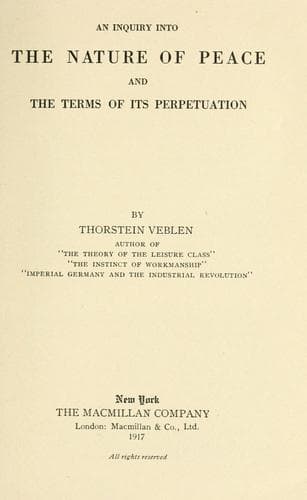
An Inquiry into the Nature of Peace and the Terms of Its PerpetuationVeblen, Thorstein
Philosophy
An Inquiry into the Nature of Peace and the Terms of Its Perpetuation
Veblen, Thorstein
Peace; World War, 1914-1918 -- Peace
What is required to insure the maintenance of peace among pacific
nations is the neutralisation of all those human relations out of which
international grievances are wont to arise. And what is necessary to
assure a reasonable expectation of continued peace is the neutralisation
of so much of these relations as the patriotic self-conceit and
credulity of these peoples will permit. These two formulations are by no
means identical; indeed, the disparity between what could advantageously
be dispensed with in the way of national rights and pretensions, and
what the common run of modern patriots could be induced to relinquish,
is probably much larger than any sanguine person would like to believe.
It should be plain on slight reflection that the greater part, indeed
substantially the whole, of those material interests and demands that
now engage the policy of the nations, and that serve on occasion to set
them at variance, might be neutralised or relinquished out of hand,
without detriment to any one of the peoples concerned.
The greater part of these material interests over which the various
national establishments keep watch and hold pretensions are, in point of
historical derivation, a legacy from the princely politics of what is
called the "Mercantilist" period; and they are uniformly of the nature
of gratuitous interference or discrimination between the citizens of the
given nation and outsiders. Except (doubtfully) in the English case,
where mercantilist policies are commonly believed to have been adopted
directly for the benefit of the commercial interest, measures of this
nature are uniformly traceable to the endeavours of the crown and its
officers to strengthen the finances of the prince and give him an
advantage in warlike enterprise. They are kept up essentially for the
same eventual end of preparation for war. So, e.g., protective tariffs,
and the like discrimination in shipping, are still advocated as a means
of making the nation self-supporting, self-contained, self-sufficient;
with a view to readiness in the event of hostilities.
A nation is in no degree better off in time of peace for being
self-sufficient. In point of patent fact no nation can be industrially
self-sufficient except at the cost of foregoing some of the economic
advantages of that specialisation of industry which the modern state of
the industrial arts enforces. In time of peace there is no benefit
comes to the community at large from such restraint of trade with the
outside world, or to any class or section of the community except those
commercial concerns that are favored by the discrimination; and these
invariably gain their special advantage at the cost of their
compatriots. Discrimination in trade--export, import or shipping--has no
more beneficial effect when carried out publicly by the national
authorities than when effected surreptitiously and illegally by a
private conspiracy in restraint of trade within a group of interested
business concerns.
Public-domain text, read in full here on John Shaqi.
Reviews
Reviews
No reviews yet
Be the first to share your thoughts on this work.
Elsewhere in the archive
Join the Discussion
Join the discussion
Sign in to leave a comment or review.
Sign InorCreate an account