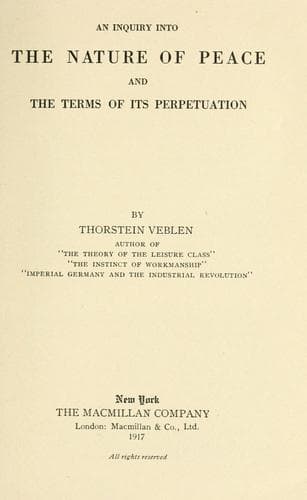
An Inquiry into the Nature of Peace and the Terms of Its PerpetuationVeblen, Thorstein
Philosophy
An Inquiry into the Nature of Peace and the Terms of Its Perpetuation
Veblen, Thorstein
Peace; World War, 1914-1918 -- Peace
Cumulatively effective usage and the exigencies of a large, varied,
shifting and extensive maritime trade have in the course of time
brought merchant shipping to something approaching a neutral footing.
For most, one might venture to say for virtually all, routine purposes
of business and legal liability the merchant shipping comes under the
jurisdiction of the local courts, without reservation. It is true, there
still are formalities and reservations which enable questions arising
out of incidents in the shipping trade to become subject of
international conference and adjustment, but they are after all not such
as would warrant the erection of national apparatus to take care of them
in case they were not already covered by usage to that effect. The
visible drift of usage toward neutralisation in merchant shipping, in
maritime trade, and in international commercial transactions, together
with the similarly visible feasibility of a closer approach to
unreserved neutralisation of this whole range of traffic, suggests that
much the same line of considerations should apply as regards the
personal and pecuniary rights of citizens traveling or residing abroad.
The extreme,--or, as seen from the present point of view, the
ultimate--term in the relinquishment of national pretensions along this
line would of course be the neutralisation of citizenship.
This is not so sweeping a move as a patriotically-minded person might
imagine on the first alarm, so far as touches the practical status of
the ordinary citizen in his ordinary relations, and particularly among
the English-speaking peoples. As an illustrative instance, citizenship
has sat somewhat lightly on the denizens of the American republic, and
with no evident damage to the community at large or to the inhabitants
in detail. Naturalisation has been easy, and has been sought with no
more eagerness, on the whole, than the notably low terms of its
acquirement would indicate. Without loss or discomfort many law-abiding
aliens have settled in this country and spent the greater part of a
life-time under its laws without becoming citizens, and no one the worse
or the wiser for it. Not infrequently the decisive inducement to
naturalisation on the part of immigrant aliens has been, and is, the
desirability of divesting themselves of their rights of citizenship in
the country of their origin. Not that the privilege and dignity of
citizenship, in this or in any other country, is to be held of little
account. It is rather that under modern civilised conditions, and among
a people governed by sentiments of humanity and equity, the stranger
within our gates suffers no obloquy and no despiteful usage for being a
stranger. It may be admitted that of late, with the fomentation of a
more accentuated nationalism by politicians seeking a _raison d'etre_,
additional difficulties have been created in the way of naturalisation
and the like incidents. Still, when all is told of the average American
Public-domain text, read in full here on John Shaqi.
Reviews
Reviews
No reviews yet
Be the first to share your thoughts on this work.
Elsewhere in the archive
Join the Discussion
Join the discussion
Sign in to leave a comment or review.
Sign InorCreate an account