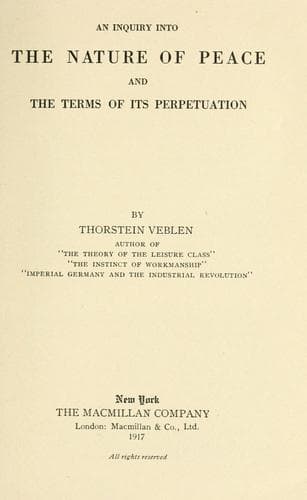
An Inquiry into the Nature of Peace and the Terms of Its PerpetuationVeblen, Thorstein
Philosophy
An Inquiry into the Nature of Peace and the Terms of Its Perpetuation
Veblen, Thorstein
Peace; World War, 1914-1918 -- Peace
Hitherto the common man has found it difficult to divest himself of an
habitual delusion on this head, handed down out of the past and
inculcated by interested politicians, to the effect that in some
mysterious way he stands to gain by limiting his own opportunities. But
the neutralisation of international trade, or the abrogation of all
discrimination in trade, is the beginning of wisdom as touches the
perpetuation of peace. The first effect of such a neutral policy would
be wider and more intricately interlocking trade relations, coupled with
a further specialisation and mutual dependence of industry between the
several countries concerned; which would mean, in terms of international
comity, a lessened readiness for warlike operations all around.
It used to be an argument of the free-traders that the growth of
international commercial relations under a free-trade policy would
greatly conduce to a spirit of mutual understanding and forbearance
between the nations. There may or may not be something appreciable in
the contention; it has been doubted, and there is no considerable
evidence to be had in support of it. But what is more to the point is
the tangible fact that such specialisation of industry and consequent
industrial interdependence would leave all parties to this relation less
capable, materially and spiritually, to break off amicable relations. So
again, in time of peace and except with a view to eventual hostilities,
it would involve no loss, and presumably little pecuniary gain, to any
country, locality, town or class, if all merchant shipping were
registered indiscriminately under neutral colors and sailed under the
neutral no-man's flag, responsible indiscriminately to the courts where
they touched or where their business was transacted.
Neither producers, shippers, merchants nor consumers have any slightest
interest in the national allegiance of the carriers of their freight,
except such as may artificially be induced by discriminatory shipping
regulations. In all but the name--in time of peace--the world's merchant
shipping already comes near being so neutralised, and the slight further
simplification required to leave it on a neutral peace footing would be
little else than a neglect of such vexatious discrimination as is still
in force. If no nation could claim the allegiance, and therefore the
usufruct, of any given item of merchant shipping in case of eventual
hostilities, on account of the domicile of the owners or the port of
registry, that would create a further handicap on eventual warlike
enterprise and add so much to the margin of tolerance. At the same time,
in the event of hostilities, shipping sailing under the neutral no-man's
flag and subject to no national allegiance would enjoy such immunities
as still inure to neutral shipping. It is true, neutrality has not
carried many immunities lately.
Public-domain text, read in full here on John Shaqi.
Reviews
Reviews
No reviews yet
Be the first to share your thoughts on this work.
Elsewhere in the archive
Join the Discussion
Join the discussion
Sign in to leave a comment or review.
Sign InorCreate an account