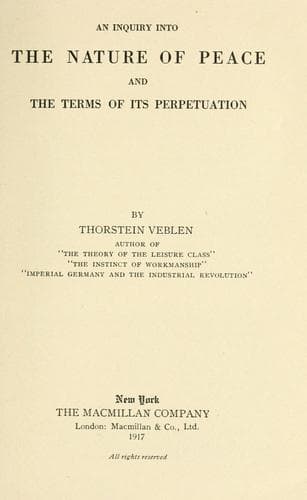
An Inquiry into the Nature of Peace and the Terms of Its PerpetuationVeblen, Thorstein
Philosophy
An Inquiry into the Nature of Peace and the Terms of Its Perpetuation
Veblen, Thorstein
Peace; World War, 1914-1918 -- Peace
In this American case the balance of effectual public opinion hitherto
is to all appearance quite in doubt, but it is also quite unsettled. The
first response has been a display of patriotic emotion and national
self-assertion. The further, later and presumably more deliberate,
expressions of opinion carry a more obvious note of apprehension and
less of stubborn or unreflecting national pride. It may be too early to
anticipate a material shift of base, to a more neutral, or less
exclusively national footing in matters of the common defense.
The national administration has been moving at an accelerated rate in
the direction not of national isolation and self-reliance resting on a
warlike equipment formidable enough to make or break the peace at
will--such as the more truculent and irresponsible among the politicians
have spoken for--but rather in the direction of moderating or curtailing
all national pretensions that are not of undoubted material consequence,
and of seeking a common understanding and concerted action with those
nationalities whose effectual interests in the matters of peace and war
coincide with the American. The administration has grown visibly more
pacific in the course of its exacting experience,--more resolutely, one
might even say more aggressively pacific; but the point of chief
attention in all this strategy of peace has also visibly been shifting
somewhat from the maintenance of a running equilibrium between
belligerents and a keeping of the peace from day to day, to the ulterior
and altogether different question of what is best to be done toward a
conclusive peace at the close of hostilities, and the ways and means of
its subsequent perpetuation.
This latter is, in effect, an altogether different question from that of
preserving neutrality and amicable relations in the midst of importunate
belligerents, and it may even, conceivably, perhaps not unlikely, come
to involve a precautionary breach of the current peace and a taking of
sides in the war with an urgent view to a conclusive outcome. It would
be going too far to impute to the administration, at the present stage,
such an aggressive attitude in its pursuit of a lasting peace as could
be called a policy of defensive offense; but it will shock no one's
sensibilities to say that such a policy, involving a taking of sides and
a renouncing of national isolation, is visibly less remote from the
counsels of the administration today than it has been at any earlier
period.
Public-domain text, read in full here on John Shaqi.
Reviews
Reviews
No reviews yet
Be the first to share your thoughts on this work.
Elsewhere in the archive
Join the Discussion
Join the discussion
Sign in to leave a comment or review.
Sign InorCreate an account