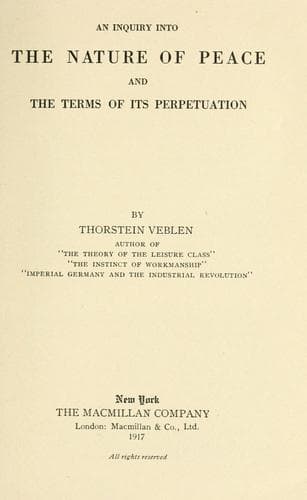
An Inquiry into the Nature of Peace and the Terms of Its PerpetuationVeblen, Thorstein
Philosophy
An Inquiry into the Nature of Peace and the Terms of Its Perpetuation
Veblen, Thorstein
Peace; World War, 1914-1918 -- Peace
In this pacific attitude, increasingly urgent and increasingly
far-reaching and apprehensive, the administration appears to be speaking
for the common man rather than for the special interests or the
privileged classes. Such would appear, on the face of the returns, to be
the meaning of the late election. It is all the more significant on that
account, since in the long run it is after all the common man that will
have to pass on the expediency of any settled line of policy and to bear
the material burden of carrying it into effect.
It may seem rash to presume that a popularly accredited administration
in a democratic country must approximately reflect the effectual changes
of popular sentiment and desire. Especially would it seem rash to anyone
looking on from the point of view of an undemocratic nation, and
therefore prone to see the surface fluctuations of excitement and
shifting clamor. But those who are within the democratic pale will know
that any administration in such a country, where official tenure and
continued incumbency of the party rest on a popular vote,--any such
administration is a political organisation and is guided by political
expediency, in the tawdry sense of the phrase. Such a political
situation has the defects of its qualities, as has been well and
frequently expounded by its critics, but it has also the merits of its
shortcomings. In a democracy of this modern order any incumbent of high
office is necessarily something of a politician, quite indispensably so;
and a politician at the same time necessarily is something of a
demagogue. He yields to the popular drift, or to the set of opinion and
demands among the effective majority on whom he leans; and he can not
even appear to lead, though he may surreptitiously lead opinion in
adroitly seeming to reflect it and obey it. Ostensible leadership, such
as has been staged in this country from time to time, has turned out to
be ostensible only. The politician must be adroit; but if he is also to
be a statesman he must be something more. He is under the necessity of
guessing accurately what the drift of events and opinion is going to be
on the next reach ahead; and in taking coming events by the forelock he
may be able to guide and shape the drift of opinion and sentiment
somewhat to his own liking. But all the while he must keep within the
lines of the long-term set of the current as it works out in the habits
of thought of the common man.
Public-domain text, read in full here on John Shaqi.
Reviews
Reviews
No reviews yet
Be the first to share your thoughts on this work.
Elsewhere in the archive
Join the Discussion
Join the discussion
Sign in to leave a comment or review.
Sign InorCreate an account