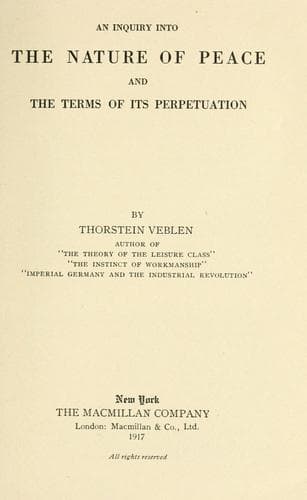
An Inquiry into the Nature of Peace and the Terms of Its PerpetuationVeblen, Thorstein
Philosophy
An Inquiry into the Nature of Peace and the Terms of Its Perpetuation
Veblen, Thorstein
Peace; World War, 1914-1918 -- Peace
Here, again, is a sinister contingency; sinister, that is, for those
vested rights of ownership by force of which the owners of "capital" are
enabled to permit or withhold the use of the industrial arts by the
community at large, on pain of privation in case the accustomed toll to
the owners of capital is not paid. It is, of course, not intended to
find fault with this arrangement; which has the sanction of "time
immemorial" and of a settled persuasion that it lies at the root of all
civilised life and intercourse. It is only that in case of extreme need
this presumed indispensable expedient of industrial control has broken
down, and that experience is proving it to be, in these premises, an
item of borrowed trouble. Should experience continue to run on the same
lines for an appreciable period and at a high tension, it is at least
conceivable that the vested right of owners to employ unlimited sabotage
in the quest of profits might fall so far into disrepute as to leave
them under a qualified doubt on the return of "normal" conditions. The
common man, in other words, who gathers nothing but privation and
anxiety from the owners' discretionary sabotage, may conceivably stand
to lose his preconception that the vested rights of ownership are the
cornerstone of his life, liberty and pursuit of happiness.
* * * * *
The considerations recited in this lengthy excursion on the war
situation and its probable effects on popular habits of thought in the
United Kingdom go to say that when peace comes to be negotiated, with
the United Kingdom as the chief constituent and weightiest spokesman of
the allied nations and of the league of pacific neutrals, the
representatives of British aims and opinions are likely to speak in a
different, chastened, and disillusioned fashion, as contrasted with what
the British attitude was at the beginning of hostilities. The
gentlemanly British animus of arrogant self-sufficiency will have been
somewhat sobered, perhaps somewhat subdued. Concession to the claims and
pretensions of the other pacific nations is likely to go farther than
might once have been expected, particularly in the way of concession to
any demand for greater international comity and less international
discrimination; essentially concession looking to a reduction of
national pretensions and an incipient neutralisation of national
interests. Coupled with this will presumably be a less conciliatory
attitude toward the members of the dynastic coalition against whom the
war has been fought, owing to a more mature realisation of the
impossibility of a lasting peace negotiated with a Power whose
substantial core is a warlike and irresponsible dynastic establishment.
The peace negotiations are likely to run on a lower level of diplomatic
deference to constituted authorities, and with more of a view to the
interests and sentiments of the underlying population, than was evident
Public-domain text, read in full here on John Shaqi.
Reviews
Reviews
No reviews yet
Be the first to share your thoughts on this work.
Elsewhere in the archive
Join the Discussion
Join the discussion
Sign in to leave a comment or review.
Sign InorCreate an account