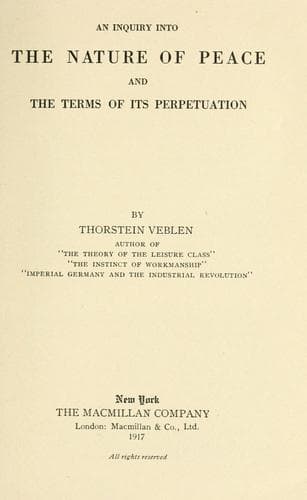
An Inquiry into the Nature of Peace and the Terms of Its PerpetuationVeblen, Thorstein
Philosophy
An Inquiry into the Nature of Peace and the Terms of Its Perpetuation
Veblen, Thorstein
Peace; World War, 1914-1918 -- Peace
in the futile negotiations had at the outbreak of hostilities. The
gentle art of diplomacy, that engages the talents of exalted personages
and well-bred statesmen, has been somewhat discredited; and if it turns
out that the vulgarisation of the directorate in the United Kingdom and
its associated allies and neutrals will have time to go on to something
like dominance and authenticity, then the deference which the spokesmen
of these nations are likely to show for the prescriptive rights of
dynasty, nobility, bureaucracy, or even of pecuniary aristocracy, in the
countries that make up the party of the second part, may be expected to
have shrunk appreciably, conceivably even to such precarious dimensions
as to involve the virtual neglect or possible downright abrogation of
them, in sum and substance.
Indeed, the chances of a successful pacific league of neutrals to come
out of the current situation appear to be largely bound up with the
degree of vulgarisation due to overtake the several directorates of the
belligerent nations as well as the popular habits of thought in these
and in the neutral countries, during the further course of the war. It
is too broad a generalisation, perhaps, to say that the longer the war
lasts the better are the chances of such a neutral temper in the
interested nations as will make a pacific league practicable, but the
contrary would appear a much less defensible proposition. It is, of
course, the common man that has the least interest in warlike
enterprise, if any, and it is at the same time the common man that bears
the burden of such enterprise and has also the most immediate interest
in keeping the peace. If, slowly and pervasively, in the course of hard
experience, he learns to distrust the conduct of affairs by his betters,
and learns at the same move to trust to his own class to do what is
necessary and to leave undone what is not, his deference to his betters
is likely to suffer a decline, such as should show itself in a somewhat
unguarded recourse to democratic ways and means.
In short, there is in this progressive vulgarisation of effectual use
and wont and of sentiment, in the United Kingdom and elsewhere, some
slight ground for the hope, or the apprehension, that no peace will be
made with the dynastic Powers of the second part until they cease to be
dynastic Powers and take on the semblance of democratic commonwealths,
with dynasties, royalties and privileged classes thrown in the discard.
Public-domain text, read in full here on John Shaqi.
Reviews
Reviews
No reviews yet
Be the first to share your thoughts on this work.
Elsewhere in the archive
Join the Discussion
Join the discussion
Sign in to leave a comment or review.
Sign InorCreate an account