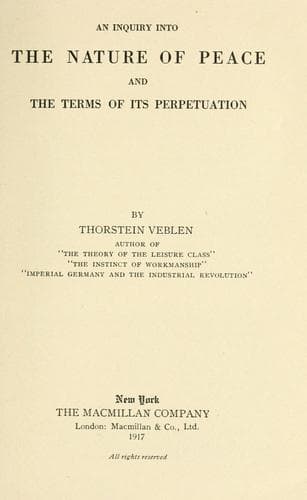
An Inquiry into the Nature of Peace and the Terms of Its PerpetuationVeblen, Thorstein
Philosophy
An Inquiry into the Nature of Peace and the Terms of Its Perpetuation
Veblen, Thorstein
Peace; World War, 1914-1918 -- Peace
This would probably mean some prolongation of hostilities, until the
dynasties and privileged classes had completely exhausted their
available resources; and, by the same token, until the privileged
classes in the more modern nations among the belligerents had also been
displaced from direction and discretion by those underbred classes on
whom it is incumbent to do what is to be done; or until a juncture were
reached that comes passably near to such a situation. On the contingency
of such a course of events and some such outcome appears also to hang
the chance of a workable pacific league. Without further experience of
the futility of upper-class and pecuniary control, to discredit
precedent and constituted authority, it is scarcely conceivable, e.g.,
that the victorious allies would go the length of coercively discarding
the German Imperial dynasty and the kept classes that with it constitute
the Imperial State, and of replacing it with a democratic organisation
of the people in the shape of a modern commonwealth; and without a
change of that nature, affecting that nation and such of its allies as
would remain on the map, no league of pacific neutrals would be able to
manage its affairs, even for a time, except on a war-footing that would
involve a competitive armament against future dynastic enterprises from
the same quarter. Which comes to saying that a lasting peace is possible
on no other terms than the disestablishment of the Imperial dynasty and
the abrogation of all feudalistic remnants of privilege in the
Fatherland and its allies, together with the reduction of those
countries to the status of commonwealths made up of ungraded men.
* * * * *
It is easy to speculate on what the conditions precedent to such a
pacific league of neutrals must of necessity be; but it is not therefore
less difficult to make a shrewd guess as to the chances of these
conditions being met. Of these conditions precedent, the chief and
foremost, without which any other favorable circumstances are
comparatively idle, is a considerable degree of neutralisation,
extending to virtually all national interests and pretensions, but more
particularly to all material and commercial interests of the federated
peoples; and, indispensably and especially, such neutralisation would
have to extend to the nations from whom aggression is now apprehended,
as, e.g., the German people. But such neutralisation could not
conceivably reach the Fatherland unless that nation were made over in
the image of democracy, since the Imperial State is, by force of the
terms, a warlike and unneutral power. This would seem to be the
ostensibly concealed meaning of the allied governments in proclaiming
that their aim is to break German militarism without doing harm to the
German people.
Public-domain text, read in full here on John Shaqi.
Reviews
Reviews
No reviews yet
Be the first to share your thoughts on this work.
Elsewhere in the archive
Join the Discussion
Join the discussion
Sign in to leave a comment or review.
Sign InorCreate an account