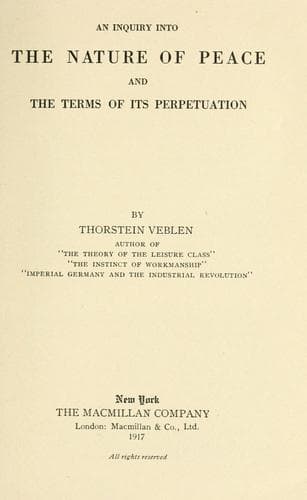
An Inquiry into the Nature of Peace and the Terms of Its PerpetuationVeblen, Thorstein
Philosophy
An Inquiry into the Nature of Peace and the Terms of Its Perpetuation
Veblen, Thorstein
Peace; World War, 1914-1918 -- Peace
(3) Cancelment of the public debt, of the Empire and of its
members--creditors of the Empire being accounted accessory to the
culpable enterprise of the Imperial government;
(4) Confiscation of such industrial equipment and resources as have
contributed to the carrying on of the war, as being also accessory;
(5) Assumption by the league at large of all debts incurred, by the
Entente belligerents or by neutrals, for the prosecution or by reason of
the war, and distribution of the obligation so assumed, impartially
among the members of the league, including the peoples of the defeated
nations;
(6) Indemnification for all injury done to civilians in the invaded
territories; the means for such indemnification to be procured by
confiscation of all estates in the defeated countries exceeding a
certain very modest maximum, calculated on the average of property
owned, say, by the poorer three-fourths of the population,--the kept
classes being properly accounted accessory to the Empire's culpable
enterprise.
The proposition to let the war debt be shared by all members of the
league on a footing of impartial equality may seem novel, and perhaps
extravagant. But all projects put forth for safeguarding the world's
peace by a compact among the pacific nations run on the patent, though
often tacit, avowal that the Entente belligerents are spending their
substance and pledging their credit for the common cause. Among the
Americans, the chief of the neutral nations, this is coming to be
recognised more and more overtly. So that, in this instance at least, no
insurmountable reluctance to take over their due share of the common
burden should fairly be looked for, particularly when it appears that
the projected league, if it is organised on a footing of neutrality,
will relieve the republic of virtually all outlay for their own defense.
Of course, there is, in all this, no temerarious intention to offer
advice as to what should be done by those who have it to do, or even to
sketch the necessary course which events are bound to take. As has been
remarked in another passage, that would have to be a work of prophesy or
of effrontery, both of which, it is hoped, lie equally beyond the
horizon of this inquiry; which is occupied with the question of what
conditions will logically have to be met in order to an enduring peace,
not what will be the nature and outcome of negotiations entered into by
astute delegates pursuing the special advantage, each of his own nation.
And yet the peremptory need of reaching some practicable arrangement
whereby the peace may be kept, goes to say that even the most astute
negotiations will in some degree be controlled by that need, and may
reasonably be expected to make some approach to the simple and obvious
requirements of the situation.
* * * * *
Public-domain text, read in full here on John Shaqi.
Reviews
Reviews
No reviews yet
Be the first to share your thoughts on this work.
Elsewhere in the archive
Join the Discussion
Join the discussion
Sign in to leave a comment or review.
Sign InorCreate an account