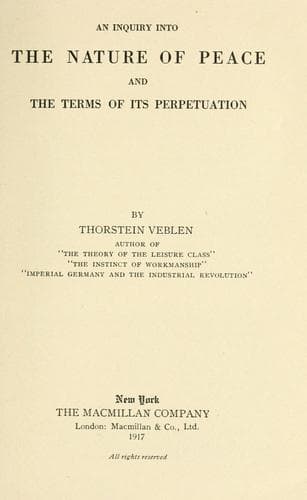
An Inquiry into the Nature of Peace and the Terms of Its PerpetuationVeblen, Thorstein
Philosophy
An Inquiry into the Nature of Peace and the Terms of Its Perpetuation
Veblen, Thorstein
Peace; World War, 1914-1918 -- Peace
Therefore the argument returns to the United Kingdom and the probable
limit of tolerance of that people, in respect of what they are likely to
insist on as a necessary measure of democratisation in the nations of
the second part, and what measure of national abnegation they are likely
to accommodate themselves to. The United Kingdom is indispensable to the
formation of a pacific league of neutrals. And the British terms of
adhesion, or rather of initiation of such a league, therefore, will have
to constitute the core of the structure, on which details may be
adjusted and to which concessive adjustments will have to be made by all
the rest. This is not saying that the projected league must or will be
dominated by the United Kingdom or administered in the British interest.
Indeed, it can not well be made to serve British particular interests in
any appreciable degree, except at the cost of defeat to its main
purpose; since the purposes of an enduring peace can be served only by
an effectual neutralisation of national claims and interests. But it
would mean that the neutralisation of national interests and
discriminations to be effected would have to be drawn on lines
acceptable to British taste in these matters, and would have to go
approximately so far as would be dictated by the British notions of what
is expedient, and not much farther. The pacific league of neutrals would
have much of a British air, but "British" in this connection is to be
taken as connoting the English-speaking countries rather than as
applying to the United Kingdom alone; since the entrance of the British
into the league would involve the entrance of the British colonies, and,
indeed, of the American republic as well.
The temper and outlook of this British community, therefore, becomes a
matter of paramount importance in any attempted analysis of the
situation resulting after the war, or of any prospective course of
conduct to be entered on by the pacific nations. And the question
touches not so much the temper and preconceptions of the British
community as known in recent history, but rather as it is likely to be
modified by the war experience. So that the practicability of a neutral
league comes to turn, in great measure, on the effect which this war
experience is having on the habits of thought of the British people, or
on that section of the British population which will make up the
effectual majority when the war closes. The grave interest that attaches
to this question must serve as justification for pursuing it farther,
even though there can be no promise of a definite or confident answer to
be found beforehand.
Public-domain text, read in full here on John Shaqi.
Reviews
Reviews
No reviews yet
Be the first to share your thoughts on this work.
Elsewhere in the archive
Join the Discussion
Join the discussion
Sign in to leave a comment or review.
Sign InorCreate an account