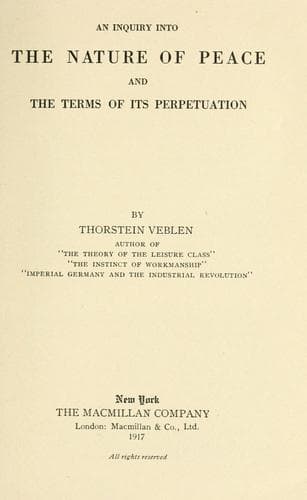
An Inquiry into the Nature of Peace and the Terms of Its PerpetuationVeblen, Thorstein
Philosophy
An Inquiry into the Nature of Peace and the Terms of Its Perpetuation
Veblen, Thorstein
Peace; World War, 1914-1918 -- Peace
Embedded in the common sense of the British population at large is a
certain large and somewhat sullen sense of fair dealing. In this they
are not greatly different from their neighbours, if at all, except that
the body of common sense in which this British sense of fair dealing
lies embedded is a maturer fashion of common sense than that which
serves to guide the workday life of many of their neighbours. And the
maturity in question appears to be chiefly a matter of their having
unlearned, divested themselves of, or been by force of disuse divested
of, an exceptionally large proportion of that burden of untoward
conceits which western Europe, and more particularly middle Europe, at
large has carried over from the Middle Ages. They have had time and
occasion to forget more of what the exigencies of modern life make it
expedient to have forgotten. And yet they are reputed slow,
conservative. But they have been well placed for losing much of what
would be well lost.
Among other things, their preconception of national animosity is not
secure, in the absence of provocation. They are now again in a position
to learn to do without some of the useless legacy out of the
past,--useless, that is, for life as it runs today, however it may be
rated in the setting in which it was all placed in that past out of
which it has come. And the question is whether now, under the pressure
of exigencies that make for a disestablishment of much cumbersome
inherited apparatus for doing what need not be done, they will be ruled
by their sense of expediency and of fair dealing to the extent of
cancelling out of their own scheme of life so much of this legacy of
conventional preconceptions as has now come visibly to hinder their own
material well-being, and at the same time to defeat that peace and
security for which they have shown themselves willing to fight. It is,
of course, a simpler matter to fight than it is to put away a
preconceived, even if it is a bootless, superstition; as, e.g., the
prestige of hereditary wealth, hereditary gentility, national
vainglory, and perhaps especially national hatred. But if the school is
hard enough and the discipline protracted enough there is no reason in
the nature of things why the common run of the British people should not
unlearn these futilities that once were the substance of things under an
older and outworn order. They have already shown their capacity for
divesting themselves of outworn institutional bonds, in discarding the
main substance of dynastic rule; and when they now come to face the
exigencies of this new situation it should cause no great surprise if
they are able to see their way to do what further is necessary to meet
these exigencies.
* * * * *
Public-domain text, read in full here on John Shaqi.
Reviews
Reviews
No reviews yet
Be the first to share your thoughts on this work.
Elsewhere in the archive
Join the Discussion
Join the discussion
Sign in to leave a comment or review.
Sign InorCreate an account