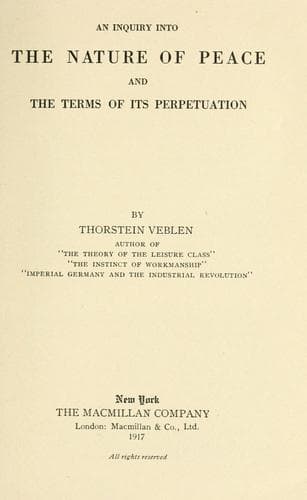
An Inquiry into the Nature of Peace and the Terms of Its PerpetuationVeblen, Thorstein
Philosophy
An Inquiry into the Nature of Peace and the Terms of Its Perpetuation
Veblen, Thorstein
Peace; World War, 1914-1918 -- Peace
There is no intention herewith to express an expectation that this
out-and-out neutralisation of the Fatherland's international relations
and of its dynastic government will come to pass on the return of peace,
or that the German people will, as a precaution against recurrent
Imperial rabies, be organised on a democratic pattern by constraint of
the pacific nations of the league. The point is only that this measure
of neutralisation appears to be the necessary condition, in the absence
of which no such neutral league can succeed, and that so long as the war
goes on there is something of a chance that the British community may in
time reach a frame of mind combining such settled determination to
safeguard the peace at all costs, with such a degree of disregard for
outworn conventions, that their spokesmen in the negotiations may push
the neutralisation of these peoples to that length.
The achievement of such an outcome would evidently take time as well as
harsh experience, more time and harsher experience, perhaps, than one
likes to contemplate.
Most men, therefore, would scarcely rate the chance of such an outcome
at all high. And yet it is to be called to mind that the war has lasted
long and the effect of its demands and its experience has already gone
far, and that the longer it lasts the greater are the chances of its
prolongation and of its continued hardships, at least to the extent that
with every month of war that passes the prospect of the allied nations
making peace on any terms short of unconditional surrender grows less.
And unconditional surrender is the first step in the direction of an
unconditional dispossession of the Imperial establishment and its war
prophets,--depending primarily on the state of mind of the British
people at the time. And however unlikely, it is also always possible, as
some contend, that in the course of further war experience the common
man in the Fatherland may come to reflect on the use and value of the
Imperial establishment, with the result of discarding and disowning it
and all its works. Such an expectation would doubtless underrate the
force of ancient habit, and would also involve a misapprehension of the
psychological incidence of a warlike experience. The German people have
substantially none of those preconceptions of independence and
self-direction to go on, in the absence of which an effectual revulsion
against dynastic rule can not come to pass.
Public-domain text, read in full here on John Shaqi.
Reviews
Reviews
No reviews yet
Be the first to share your thoughts on this work.
Elsewhere in the archive
Join the Discussion
Join the discussion
Sign in to leave a comment or review.
Sign InorCreate an account