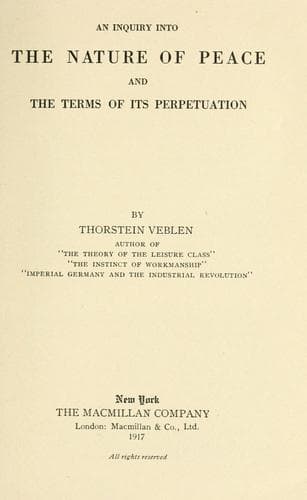
An Inquiry into the Nature of Peace and the Terms of Its PerpetuationVeblen, Thorstein
Philosophy
An Inquiry into the Nature of Peace and the Terms of Its Perpetuation
Veblen, Thorstein
Peace; World War, 1914-1918 -- Peace
There need be no imputation of sinister designs to these gentlefolk, who
so are elected by force of circumstances to guard and guide the nation's
interests. As things go, it will doubtless commonly be found that they
are as well-intentioned as need be. But a well-meaning gentleman of good
antecedents means well in a gentlemanly way and in the light of good
antecedents. Which comes unavoidably to an effectual bias in favor of
those interests which honorable gentlemen of good antecedents have at
heart. And among these interests are the interests of the kept classes,
as contrasted with that common run of the population from which their
keep is drawn.
Under the auspices, even if they are only the histrionic and decorative
auspices, of so decorous an article of institutional furniture as
royalty, it follows of logical necessity that the personnel of the
effectual government must also be drawn from the better classes, whose
place and station and high repute will make their association with the
First Gentleman of the Realm not too insufferably incongruous. And then,
the popular habit of looking up to this First Gentleman with that
deference that royalty commands, also conduces materially to the
attendant habitual attitude of deference to gentility more at large.
Even in so democratic a country, and with so exanimate a crown as is to
be found in the United Kingdom, the royal establishment visibly, and
doubtless very materially, conduces to the continued tenure of the
effectual government by representatives of the kept classes; and it
therefore counts with large effect toward the retardation of the
country's further move in the direction of democratic insubordination
and direct participation in the direction of affairs by the underbred,
who finally pay the cost. And on the other hand, even so moderately
royal an establishment as the Norwegian has apparently a sensible effect
in the way of gathering the reins somewhat into the hands of the better
classes, under circumstances of such meagerness as might be expected to
preclude anything like a "better" class, in the conventional acceptation
of that term. It would appear that even the extreme of pseudo-dynastic
royalty, sterilised to the last degree, is something of an effectual
hindrance to democratic rule, and in so far also a hindrance to the
further continued neutralisation of nationalist pretensions, as also an
effectual furtherance of upper-class rule for upper-class ends.
Public-domain text, read in full here on John Shaqi.
Reviews
Reviews
No reviews yet
Be the first to share your thoughts on this work.
Elsewhere in the archive
Join the Discussion
Join the discussion
Sign in to leave a comment or review.
Sign InorCreate an account