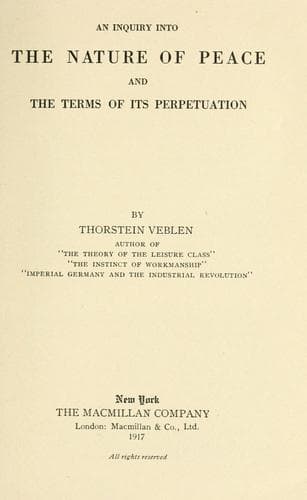
An Inquiry into the Nature of Peace and the Terms of Its PerpetuationVeblen, Thorstein
Philosophy
An Inquiry into the Nature of Peace and the Terms of Its Perpetuation
Veblen, Thorstein
Peace; World War, 1914-1918 -- Peace
Now, a government by well-meaning gentlemen-investors will, at the
nearest, come no nearer representing the material needs and interests of
the common run than a parable comes to representing the concrete facts
which it hopes to illuminate. And as bears immediately on the point in
hand, these gentlemanly administrators of the nation's affairs who so
cluster about the throne, vacant though it may be of all but the bodily
presence of majesty, are after all gentlemen, with a gentlemanly sense
of punctilio touching the large proprieties and courtesies of political
life. The national honor is a matter of punctilio, always; and out of
the formal exigencies of the national honor arise grievances to be
redressed; and it is grievances of this character that commonly afford
the formal ground of a breach of the peace. An appeal on patriotic
grounds of wounded national pride, to the common run who have no trained
sense of punctilio, by the gentlemanly responsible class who have such a
sense, backed by assurances that the national prestige or the national
interests are at stake, will commonly bring a suitable response. It is
scarcely necessary that the common run should know just what the stir is
about, so long as they are informed by their trusted betters that there
is a grievance to redress. In effect, it results that the democratic
nation's affairs are administered by a syndicate composed of the least
democratic class in the population.
Excepting what is to be excepted, it will commonly hold true today that
these gentlemanly governments are conducted in a commendably clean and
upright fashion, with a conscious rectitude and a benevolent intention.
But they are after all, in effect, class governments, and they
unavoidably carry the bias of their class. The gentlemanly officials and
law-givers come, in the main, from the kept classes, whose living comes
to them in the way of income from investments, at home or in foreign
parts, or from an equivalent source of accumulated wealth or official
emolument. The bias resulting from this state of the case need not be of
an intolerant character in order to bring its modicum of mischief into
the national policy, as regards amicable relations with other
nationalities. A slight bias running on a ground of conscious right and
unbroken usage may go far. So, e.g., anyone of these gentlemanly
governments is within its legitimate rights, or rather within its
imperative duty, in defending the foreign investments of its citizens
and enforcing due payment of its citizens' claims to income or principal
of such property as they may hold in foreign parts; and it is within its
ordinary lines of duty in making use of the nation's resources--that is
to say of the common man and his means of livelihood--in enforcing such
claims held by the investing classes. The community at large has no
interest in the enforcement of such claims; it is evidently a class
interest, and as evidently protected by a code of rights, duties and
Public-domain text, read in full here on John Shaqi.
Reviews
Reviews
No reviews yet
Be the first to share your thoughts on this work.
Elsewhere in the archive
Join the Discussion
Join the discussion
Sign in to leave a comment or review.
Sign InorCreate an account