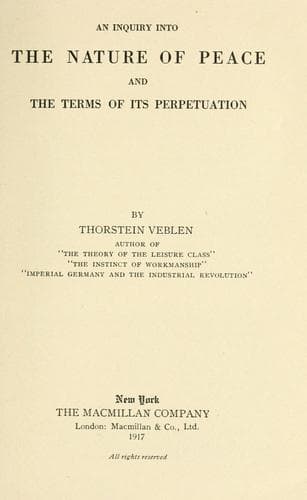
An Inquiry into the Nature of Peace and the Terms of Its PerpetuationVeblen, Thorstein
Philosophy
An Inquiry into the Nature of Peace and the Terms of Its Perpetuation
Veblen, Thorstein
Peace; World War, 1914-1918 -- Peace
Evidently the conception of peace on which its various spokesmen are
proceeding is by no means the same for all of them. In the current
German conception, e.g., as seen in the utterances of its many and
urgent spokesmen, peace appears to be of the general nature of a truce
between nations, whose God-given destiny it is, in time, to adjust a
claim to precedence by wager of battle. They will sometimes speak of it,
euphemistically, with a view to conciliation, as "assurance of the
national future," in which the national future is taken to mean an
opportunity for the extension of the national dominion at the expense of
some other national establishment. In the same connection one may recall
the many eloquent passages on the State and its paramount place and
value in the human economy. The State is useful for disturbing the
peace. This German notion may confidently be set down as the lowest of
the current conceptions of peace; or perhaps rather as the notion of
peace reduced to the lowest terms at which it continues to be
recognisable as such. Next beyond in that direction lies the notion of
armistice; which differs from this conception of peace chiefly in
connoting specifically a definite and relatively short interval between
warlike operations.
The conception of peace as being a period of preparation for war has
many adherents outside the Fatherland, of course. Indeed, it has
probably a wider vogue and a readier acceptance among men who interest
themselves in questions of peace and war than any other. It goes hand in
hand with that militant nationalism that is taken for granted,
conventionally, as the common ground of those international relations
that play a part in diplomatic intercourse. It is the diplomatist's
_metier_ to talk war in parables of peace. This conception of peace as a
precarious interval of preparation has come down to the present out of
the feudal age and is, of course, best at home where the feudal range of
preconceptions has suffered least dilapidation; and it carries the
feudalistic presumption that all national establishments are competitors
for dominion, after the scheme of Macchiavelli. The peace which is had
on this footing, within the realm, is a peace of subjection, more or
less pronounced according as the given national establishment is more or
less on the militant order; a warlike organisation being necessarily of
a servile character, in the same measure in which it is warlike.
Public-domain text, read in full here on John Shaqi.
Reviews
Reviews
No reviews yet
Be the first to share your thoughts on this work.
Elsewhere in the archive
Join the Discussion
Join the discussion
Sign in to leave a comment or review.
Sign InorCreate an account