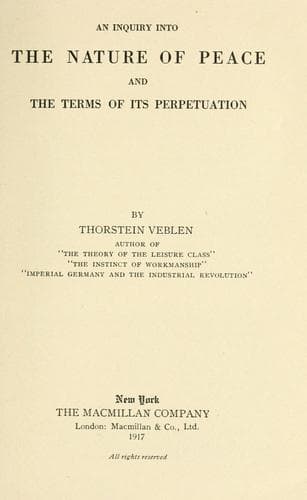
An Inquiry into the Nature of Peace and the Terms of Its PerpetuationVeblen, Thorstein
Philosophy
An Inquiry into the Nature of Peace and the Terms of Its Perpetuation
Veblen, Thorstein
Peace; World War, 1914-1918 -- Peace
In much the same measure and with much the same limitations as the
modern democratic nations have departed from the feudal system of civil
relations and from the peculiar range of conceptions which characterise
that system, they have also come in for a new or revised conception of
peace. Instead of its being valued chiefly as a space of time in which
to prepare for war, offensive or defensive, among these democratic and
provisionally pacific nations it has come to stand in the common
estimation as the normal and stable manner of life, good and commendable
in its own right. These modern, pacific, commonwealths stand on the
defensive, habitually. They are still pugnaciously national, but they
have unlearned so much of the feudal preconceptions as to leave them in
a defensive attitude, under the watch-word: Peace with honour. Their
quasi-feudalistic national prestige is not to be trifled with, though it
has lost so much of its fascination as ordinarily not to serve the
purposes of an aggressive enterprise, at least not without some shrewd
sophistication at the hands of militant politicians and their diplomatic
agents. Of course, an exuberant patriotism may now and again take on the
ancient barbarian vehemence and lead such a provisionally pacific nation
into an aggressive raid against a helpless neighbour; but it remains
characteristically true, after all, that these peoples look on the
country's peace as the normal and ordinary course of things, which each
nation is to take care of for itself and by its own force.
The ideal of the nineteenth-century statesmen was to keep the peace by a
balance of power; an unstable equilibrium of rivalries, in which it was
recognised that eternal vigilance was the price of peace by
equilibration. Since then, by force of the object-lesson of the
twentieth-century wars, it has become evident that eternal vigilance
will no longer keep the peace by equilibration, and the balance of power
has become obsolete. At the same time things have so turned that an
effective majority of the civilised nations now see their advantage in
peace, without further opportunity to seek further dominion. These
nations have also been falling into the shape of commonwealths, and so
have lost something of their national spirit.
Public-domain text, read in full here on John Shaqi.
Reviews
Reviews
No reviews yet
Be the first to share your thoughts on this work.
Elsewhere in the archive
Join the Discussion
Join the discussion
Sign in to leave a comment or review.
Sign InorCreate an account