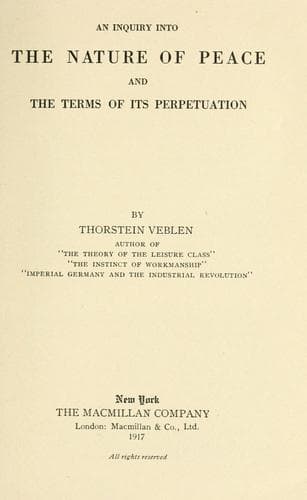
An Inquiry into the Nature of Peace and the Terms of Its PerpetuationVeblen, Thorstein
Philosophy
An Inquiry into the Nature of Peace and the Terms of Its Perpetuation
Veblen, Thorstein
Peace; World War, 1914-1918 -- Peace
The essentially feudal virtues of loyalty and bellicose patriotism would
appear to have gained their great ascendency over all men's spirit
within the Western civilisation by force of the peculiarly consistent
character of the discipline of life under feudal conditions, whether in
war or peace; and to the same uniformity of these forces that shaped the
workday habits of thought among the feudal nations is apparently due
that profound institutionalisation of the preconceptions of patriotism
and loyalty, by force of which these preconceptions still hold the
modern peoples in an unbreakable web of prejudice, after the conditions
favoring their acquirement have in great part ceased to operate. These
preconceptions of national solidarity and international enmity have come
down from the past as an integral part of the unwritten constitution
underlying all these modern nations, even those which have departed most
widely from the manner of life to which the peoples owe these ancient
preconceptions. Hitherto, or rather until recent times, the workday
experience of these peoples has not seriously worked at cross purposes
with the patriotic spirit and its bias of national animosity; and what
discrepancy there has effectively been between the discipline of workday
life and the received institutional preconceptions on this head, has
hitherto been overborne by the unremitting inculcation of these virtues
by interested politicians, priests and publicists, who speak habitually
for the received order of things.
That order of things which is known on its political and civil side as
the feudal system, together with that era of the dynastic States which
succeeds the feudal age technically so called, was, on its industrial or
technological side, a system of trained man-power organised on a plan of
subordination of man to man. On the whole, the scheme and logic of that
life, whether in its political (warlike) or its industrial doings,
whether in war or peace, runs on terms of personal capacity, proficiency
and relations. The organisation of the forces engaged and the
constraining rules according to which this organisation worked, were of
the nature of personal relations, and the impersonal factors in the case
were taken for granted. Politics and war were a field for personal
valor, force and cunning, in practical effect a field for personal force
and fraud. Industry was a field in which the routine of life, and its
outcome, turned on "the skill, dexterity and judgment of the individual
workman," in the words of Adam Smith.
Public-domain text, read in full here on John Shaqi.
Reviews
Reviews
No reviews yet
Be the first to share your thoughts on this work.
Elsewhere in the archive
Join the Discussion
Join the discussion
Sign in to leave a comment or review.
Sign InorCreate an account