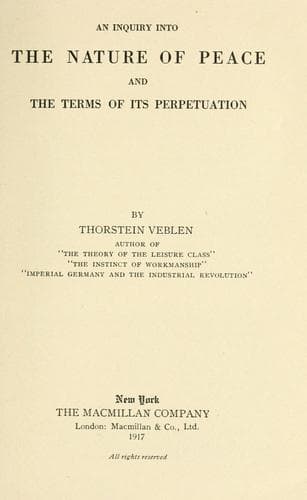
An Inquiry into the Nature of Peace and the Terms of Its PerpetuationVeblen, Thorstein
Philosophy
An Inquiry into the Nature of Peace and the Terms of Its Perpetuation
Veblen, Thorstein
Peace; World War, 1914-1918 -- Peace
By and large, it is perhaps not to be doubted that the populace now
under arms will return from the experience of the war with some net gain
in loyalty to the nation's honour and in allegiance to their masters;
particularly the German subjects,--the like is scarcely true for the
British; but a doubt will present itself as to the magnitude of this net
gain in subordination, or this net loss in self-possession. A doubt may
be permitted as to whether the common man in the countries of the
Imperial coalition, e.g., will, as the net outcome of this war
experience, be in a perceptibly more pliable frame of mind as touches
his obligations toward his betters and subservience to the irresponsible
authority exercised by the various governmental agencies, than he was at
the outbreak of the war. At that time, there is reason to believe, there
was an ominous, though scarcely threatening, murmur of discontent
beginning to be heard among the working classes of the industrial towns.
It is fair to presume, however, that the servile discipline of the
service and the vindictive patriotism bred of the fight should combine
to render the populace of the Fatherland more amenable to the
irresponsible rule of the Imperial dynasty and its subaltern royal
establishments, in spite of any slight effect of a contrary character
exercised by the training in technological methods and in self-reliance,
with which this discipline of the service has been accompanied. As to
the case of the British population, under arms or under compulsion of
necessity at home, something has already been said in an earlier
passage; and much will apparently depend, in their case, on the further
duration of the war. The case of the other nationalities involved, both
neutrals and belligerents, is even more obscure in this bearing, but it
is also of less immediate consequence for the present argument.
* * * * *
Public-domain text, read in full here on John Shaqi.
Reviews
Reviews
No reviews yet
Be the first to share your thoughts on this work.
Elsewhere in the archive
Join the Discussion
Join the discussion
Sign in to leave a comment or review.
Sign InorCreate an account