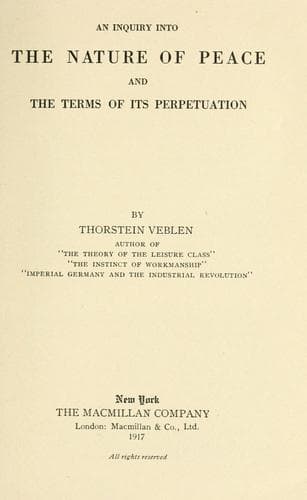
An Inquiry into the Nature of Peace and the Terms of Its PerpetuationVeblen, Thorstein
Philosophy
An Inquiry into the Nature of Peace and the Terms of Its Perpetuation
Veblen, Thorstein
Peace; World War, 1914-1918 -- Peace
The standard theories of economic science have assumed the rights of
property and contract as axiomatic premises and ultimate terms of
analysis; and their theories are commonly drawn in such a form as would
fit the circumstances of the handicraft industry and the petty trade,
and such as can be extended to any other economic situation by shrewd
interpretation. These theories, as they run from Adam Smith down through
the nineteenth century and later, appear tenable, on the whole, when
taken to apply to the economic situation of that earlier time, in
virtually all that they have to say on questions of wages, capital,
savings, and the economy and efficiency of management and production by
the methods of private enterprise resting on these rights of ownership
and contract and governed by the pursuit of private gain. It is when
these standard theories are sought to be applied to the later situation,
which has outgrown the conditions of handicraft, that they appear
nugatory or meretricious. The "competitive system" which these standard
theories assume as a necessary condition of their own validity, and
about which they are designed to form a defensive hedge, would, under
those earlier conditions of small-scale enterprise and personal contact,
appear to have been both a passably valid assumption as a premise and a
passably expedient scheme of economic relations and traffic. At that
period of its life-history it can not be said consistently to have
worked hardship to the common man; rather the reverse. And the common
man in that time appears to have had no misgivings about the excellence
of the scheme or of that article of Natural Rights that underlies it.
This complexion of things, as touches the effectual bearing of the
institution of property and the ancient customary rights of ownership,
has changed substantially since the time of Adam Smith. The "competitive
system," which he looked to as the economic working-out of that "simple
and obvious system of natural liberty" that always engaged his best
affections, has in great measure ceased to operate as a routine of
natural liberty, in fact; particularly in so far as touches the fortunes
of the common man, the impecunious mass of the people. _De jure_, of
course, the competitive system and its inviolable rights of ownership
are a citadel of Natural Liberty; but _de facto_ the common man is now,
and has for some time been, feeling the pinch of it. It is law, and
doubtless it is good law, grounded in immemorial usage and authenticated
with statute and precedent. But circumstances have so changed that this
good old plan has in a degree become archaic, perhaps unprofitable, or
even mischievous, on the whole, and especially as touches the conditions
of life for the common man. At least, so the common man in these modern
democratic and commercial countries is beginning to apprehend the
matter.
Public-domain text, read in full here on John Shaqi.
Reviews
Reviews
No reviews yet
Be the first to share your thoughts on this work.
Elsewhere in the archive
Join the Discussion
Join the discussion
Sign in to leave a comment or review.
Sign InorCreate an account