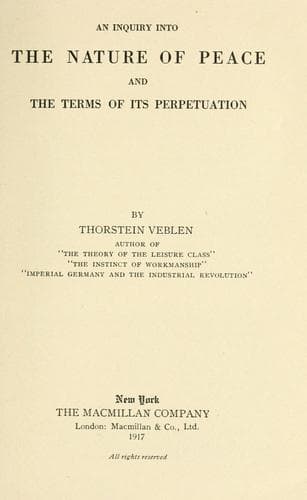
An Inquiry into the Nature of Peace and the Terms of Its PerpetuationVeblen, Thorstein
Philosophy
An Inquiry into the Nature of Peace and the Terms of Its Perpetuation
Veblen, Thorstein
Peace; World War, 1914-1918 -- Peace
Some slight and summary characterisation of these changing circumstances
that have affected the incidence of the rights of property during modern
times may, therefore, not be out of place; with a view to seeing how far
and why these rights may be due to come under advisement and possible
revision, in case a state of settled peace should leave men's attention
free to turn to these internal, as contrasted with national interests.
Under that order of handicraft and petty trade that led to the
standardisation of these rights of ownership in the accentuated form
which belongs to them in modern law and custom, the common man had a
practicable chance of free initiative and self-direction in his choice
and pursuit of an occupation and a livelihood, in so far as rights of
ownership bore on his case. At that period the workman was the main
factor in industry and, in the main and characteristically, the question
of his employment was a question of what he would do. The material
equipment of industry--the "plant," as it has come to be called--was
subject of ownership, then as now; but it was then a secondary factor
and, notoriously, subsidiary to the immaterial equipment of skill,
dexterity and judgment embodied in the person of the craftsman. The body
of information, or general knowledge, requisite to a workmanlike
proficiency as handicraftsman was sufficiently slight and simple to fall
within the ordinary reach of the working class, without special
schooling; and the material equipment necessary to the work, in the way
of tools and appliances, was also slight enough, ordinarily, to bring it
within the reach of the common man. The stress fell on the acquirement
of that special personal skill, dexterity and judgment that would
constitute the workman a master of his craft. Given a reasonable measure
of pertinacity, the common man would be able to compass the material
equipment needful to the pursuit of his craft, and so could make his way
to a livelihood; and the inviolable right of ownership would then serve
to secure him the product of his own industry, in provision for his own
old-age and for a fair start in behalf of his children. At least in the
popular conception, and presumably in some degree also in fact, the
right of property so served as a guarantee of personal liberty and a
basis of equality. And so its apologists still look on the institution.
Public-domain text, read in full here on John Shaqi.
Reviews
Reviews
No reviews yet
Be the first to share your thoughts on this work.
Elsewhere in the archive
Join the Discussion
Join the discussion
Sign in to leave a comment or review.
Sign InorCreate an account